

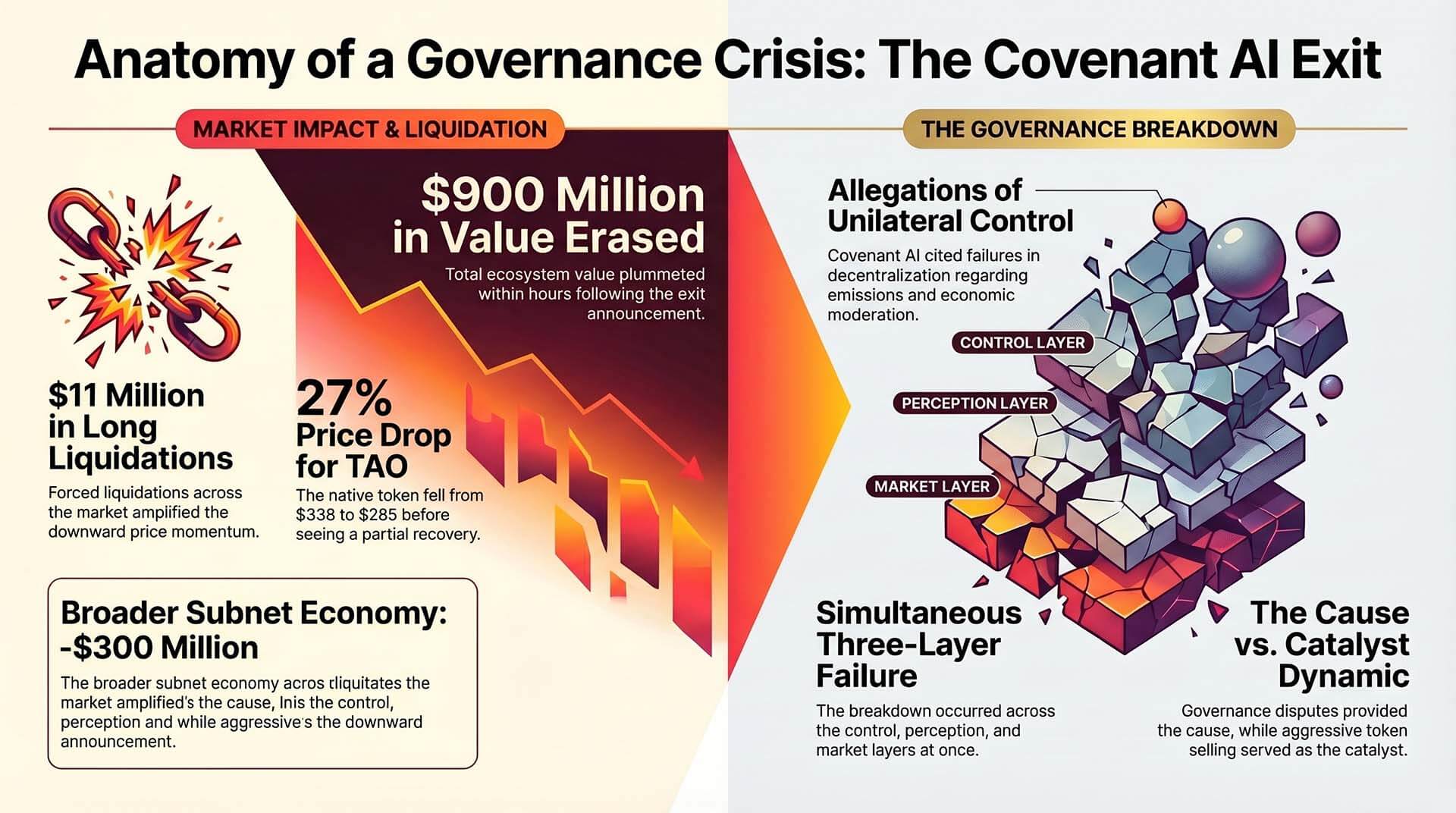
A high-profile departure from Bittensor has triggered a steep sell-off in the decentralized artificial intelligence network, wiping out nearly $900 million from its market capitalization in a matter of hours as internal disputes spill into public view.
On April 10, Covenant AI, the development team behind one of the network’s largest subnets, announced that it is abandoning the Bittensor ecosystem.
The exit of the developer who built a groundbreaking 72-billion-parameter AI model sent shockwaves through the crypto-AI sector and exposed deep ideological rifts over the network's governance.
Data from CryptoSlate showed that the price of Bittensor’s native token, TAO, plummeted 27% following the announcement, falling from $338 to a low of $285 within a two-hour window before recovering slightly to $294.
CoinGlass data also showed that the crash triggered $11 million in liquidations of long positions. Meanwhile, the collateral damage extended well beyond the core token; according to CoinGecko, over $300 million was wiped out from TAO’s broader subnet ecosystem.
Notably, the crisis abruptly halted a period of significant growth for the subnets. Over the past month, TAO has rallied 30%, driven by institutional interest and technological milestones. Just days before the crash, the network’s subnet token category boasted a combined market capitalization of over $1.5 billion.
Covenant leadership alleges Bittensor runs a ‘decentralization theatre'
At the center of the conflict are allegations of centralized control.
In a blistering statement on X, Covenant AI Founder Sam Dare accused Bittensor Co-founder Jacob Steeves, widely known in the community as Const, of operating the network as a “decentralization theatre.”
Dare wrote:
“The entire premise of Bittensor, the promise that drew builders, miners, validators, and investors into this ecosystem, is that no single entity controls it. That promise is a lie.”
Dare alleged that Steeves utilized unilateral power to reassert dominance over Covenant AI after the project grew too large to manage.
According to Dare, these actions included the sudden suspension of token emissions to Covenant's subnets, the revocation of the team's moderation capabilities over its own community channels, and the application of direct economic pressure through large, visible token sales timed to coincide with operational disputes.
Bittensor operates on a delegated structure, managed by a triumvirate that oversees a multisignature wallet for network upgrades.
However, Dare claimed this setup merely serves as a legal shield, arguing that Steeves maintains effective control and deploys network changes without decentralized consensus.
The statement reads:
“When a single actor can suspend a subnet's emissions, override an owner's authority… and use token sales as a coercive mechanism to compel compliance, that is not decentralization. It is centralized control with decentralized branding.”
Steeves has rejected these allegations on X, saying that he did not have “the ability to suspend emissions” to Covenant AI nor did he “deprecate Covenant’s channels and remove moderation rights.”
The Bittensor co-founder also stated that he sold less than 1% of what he had invested in Dare's projects.
A costly departure and ‘exit liquidity'
Despite the high-minded rhetoric regarding network governance, Covenant’s departure was marred by aggressive financial maneuvering that infuriated market participants.
Prior to the public announcement, Dare reportedly orchestrated a massive sell-off, liquidating 37,000 TAO worth of subnet alpha tokens across the Templar, Grail, and Basilica subnets.
The dump injected intense selling pressure into an already fragile market, functionally wiping out the portfolios of retail followers and investors tied to Covenant’s projects.
Crypto traders and analysts widely condemned the move as a blatant extraction of value.
The optics deteriorated further when a video on social media platform X purportedly showed Dare expressing exhaustion with the blockchain industry and a desire to “make a couple million dollars and leave.”
The juxtaposition of Dare’s governance complaints with his aggressive token dumping led to severe community backlash. Multiple users blasted the exit strategy as an egotistical and dishonorable way to settle internal network disputes, leaving retail investors to hold the bag.
A Discord spat turned into a market crash?
Inside accounts suggest the $900 million market wipeout may have stemmed from surprisingly trivial origins.
Siam Kidd, Chief Investment Officer of the Bittensor-focused DSV Fund, characterized the fallout as the culmination of an escalating interpersonal conflict rather than a genuine ideological crusade.
According to Kidd, the dispute ignited in a Discord server when Dare began deleting community messages amidst mounting user criticism. Steeves intervened by technically revoking Dare's ability to delete those messages.
This minor administrative clash reportedly escalated, prompting Steeves to sell a portion of the alpha tokens and prompting Dare to completely abandon the ecosystem.
Defending the network’s co-founder, Kidd argued that Steeves’ motives remain aligned with Bittensor’s long-term health.
He stated that “Const isn't some power-hungry troll reluctant to release control,” while brushing off the current volatility as standard “growth and teething issues” inherent to permissionless systems.
Bittensor's technical triumphs overshadowed
The acrimonious split is a major blow to Bittensor’s technical prestige as Covenant AI was not a fringe player within its ecosystem.
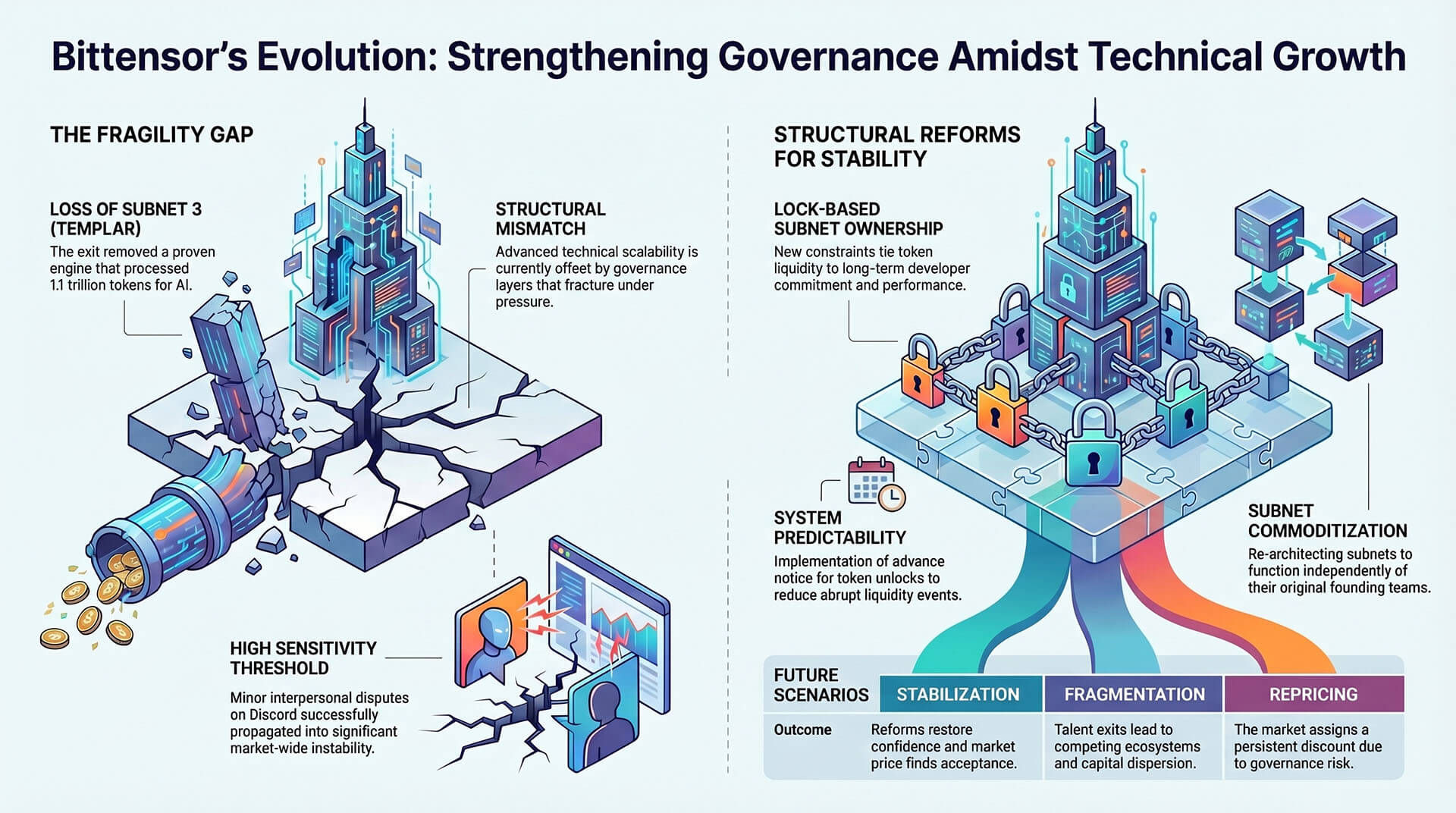
The project was the architect behind Subnet 3 (Templar), a decentralized training environment that essentially operated like Bitcoin mining for AI models.
Through this infrastructure, the team successfully trained Covenant-72B. Processing 1.1 trillion tokens across more than 70 independent contributors using standard consumer hardware, the project proved that decentralized, permissionless LLM training was viable.
The model achieved a 67.1 score on the standardized MMLU benchmark, putting it in direct competition with AI giants like Meta's Llama 2 70B.
This achievement drew high-profile validation from traditional tech titans. NVIDIA CEO Jensen Huang and venture capitalist Chamath Palihapitiya publicly praised the training methodology, framing it as a critical counterbalance to the proprietary models hoarded by Silicon Valley giants.
Covenant has vowed to take this technological framework with them to a new, undisclosed ecosystem.
Bittensor promises ecosystem resilience
In the wake of the crisis, Bittensor leadership is signaling a structural pivot to prevent future network destabilization.
While avoiding direct engagement with Dare’s specific accusations, Steeves announced that Bittensor will introduce “lock-based subnet ownership.”
This new framework is designed to explicitly tether a project's valuation to the long-term commitment of its development team.
Under the proposed mechanics, investors will have transparent, advanced notice if a subnet owner unlocks their tokens. This would allow the open market to proactively reprice a subnet before founders can use their communities as exit liquidity.
Furthermore, the system will allow investors to fluidly transfer their staked capital to alternative management teams. Steeves claims this will birth the first subnets that run “headless and as true commodities.”
At the same time, proponents of the network remain unfazed by the short-term market carnage as institutional interest in the project remains robust.
For context, Digital Currency Group’s Yuma continues to build across 14 different subnets. Additionally, the network is pressing ahead with plans to expand from 128 to 256 active subnets later this year, while the potential approval of a Grayscale TAO spot ETF looms.
The post Bittensor sheds $900 million in market value as key AI developer exits amid in-fighting appeared first on CryptoSlate.