

Since the onset of the Iran war, Dubai real estate has crashed worse than bitcoin (BTC).
The Dubai Financial Market (DFM) Real Estate Index closed trading at 13,353 on Monday, down 18.1% from 16,306 on February 27, the most recent trading session before Operation Epic Fury’s opening airstrikes at 1:15am New York time on February 28.
In contrast, BTC was trading at $65,492 when the first bombs fell on Iran. It briefly dipped to $63,000, but had rallied to $69,000 by 12:30pm Monday in New York — a 5.4% jump since the war began.
Dubai real estate lost nearly a fifth of its value over the same 10 days.
The city’s real estate market wipeout has erased all year-to-date gains and is threatening to reverse its 2025 gains which provide a mere 15% additional downside cushion before prices would revert to 2024 levels.
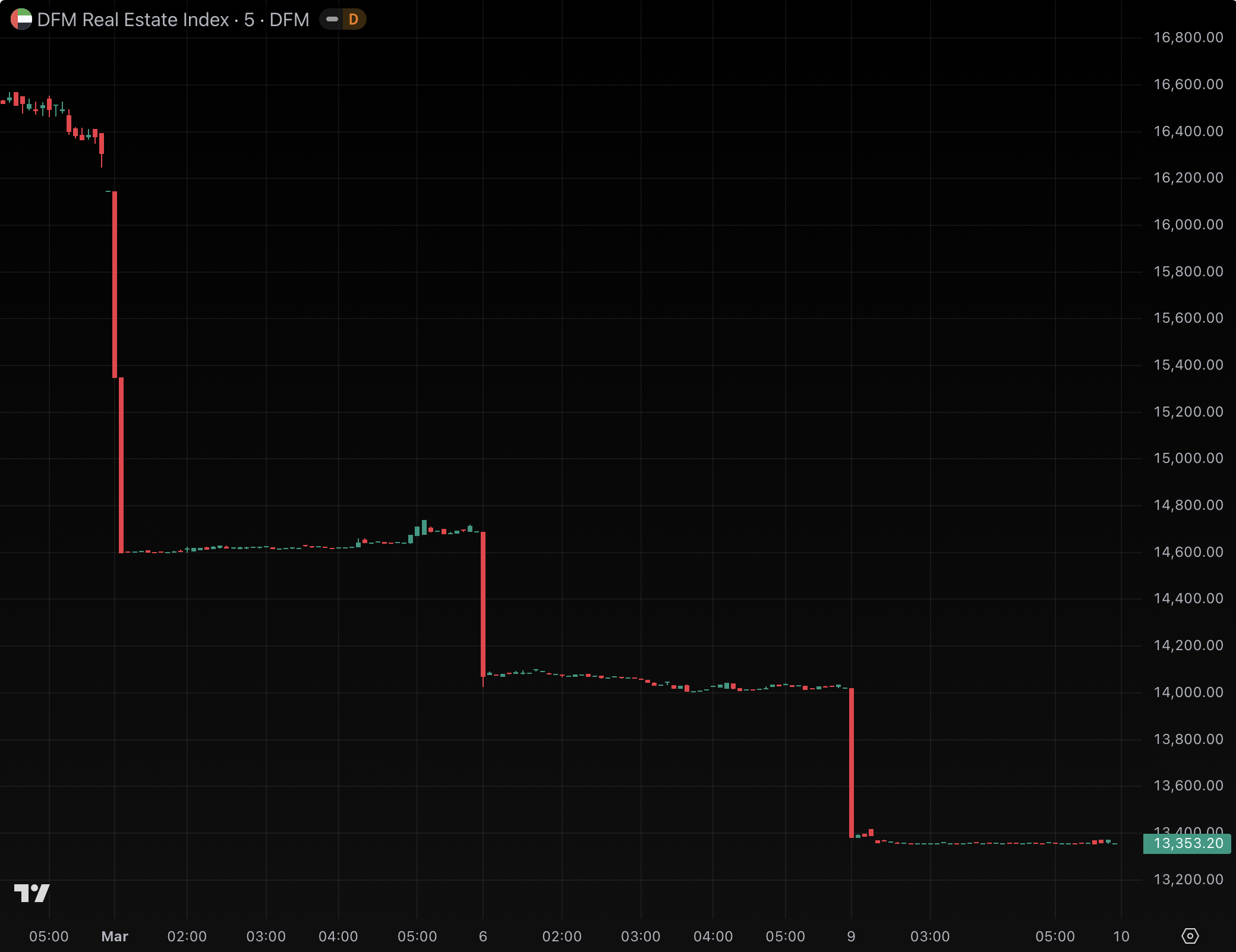
A chart of the DFM Real Estate Index shows step-like changes on each trading day along with a hard floor. For example, across four hours today, the index of real estate companies traded no lower than precisely 13,353.20.
Certain exchanges artificially limit price moves, including DFM at 5% daily.
Nearby exchange Boursa Kuwait has entirely suspended trading since March 1.
Private aircraft demand to leave Dubai is up at least 300% amid airport closures, and people are paying thousands or even six figures to flee.
Dubai bombings, drone strikes, airport closures
Dubai spent years marketing itself as a stable, tax-advantaged home for crypto influencers and it duly attracted plenty of crypto companies and influencers.
Bybit, Telegram’s TON Foundation, and Deribit have headquarters in Dubai, and many other crypto companies have offices in the city, including Binance, OKX, and Crypto.com.
Overall, 9,800 millionaires relocated to the United Arab Emirates (UAE) in 2025 alone, bringing $63 billion with them.
Then, Iran fired missiles at Dubai’s airport, luxury hotels, and civilian areas. UAE regulators closed its own stock exchanges for two full days to prevent a panic selloff.
Emaar Properties, the developer behind the Burj Khalifa, fell from 17AED on February 27 to 13.30AED today, a 22% haircut. Aldar Properties, Abu Dhabi’s largest listed developer, dropped 5% the day markets reopened. The bond market for UAE developers is only trading intermittently, with spreads blowing out across the region.
Read more: Odds swing wildly as Polymarket bets on Iran’s successor collapse
Dubai’s crypto-friendly property boom depended on foreign capital, and that capital is now heading for the exits.
In the secondary market, an aggregator tracking distressed property deals shows an average price reduction of 4.9% — for property owners who’ve had enough time to update their asking price, including several properties over 10% lower than their price days ago.
Even before the war, Fitch had warned of declines up to 15% on supply concerns alone. Analysts had already cautioned that new condo supply was set to surge in the second half of 2026, right as demand is cratering.
BTC, for all its reputation as a notoriously volatile asset, is positive since the bombs started falling. Dubai real estate, the supposedly safe store of value backed by marble lobbies and palm-shaped islands, just delivered a massive drawdown.
Got a tip? Send us an email securely via Protos Leaks. For more informed news, follow us on X, Bluesky, and Google News, or subscribe to our YouTube channel.
The post Bitcoin up, Dubai real estate down since Iran war began appeared first on Protos.