
The crypto market slump wiped $112 million from Tesla’s pretax second-quarter results. The unrealized loss reduced earnings for common stockholders by $87 million after tax, or $0.02 per diluted share.
The carrying value of Tesla's digital assets fell to $674 million at June 30, 2026, from $786 million at March 31, 2026, according to the company's Q2 shareholder update.
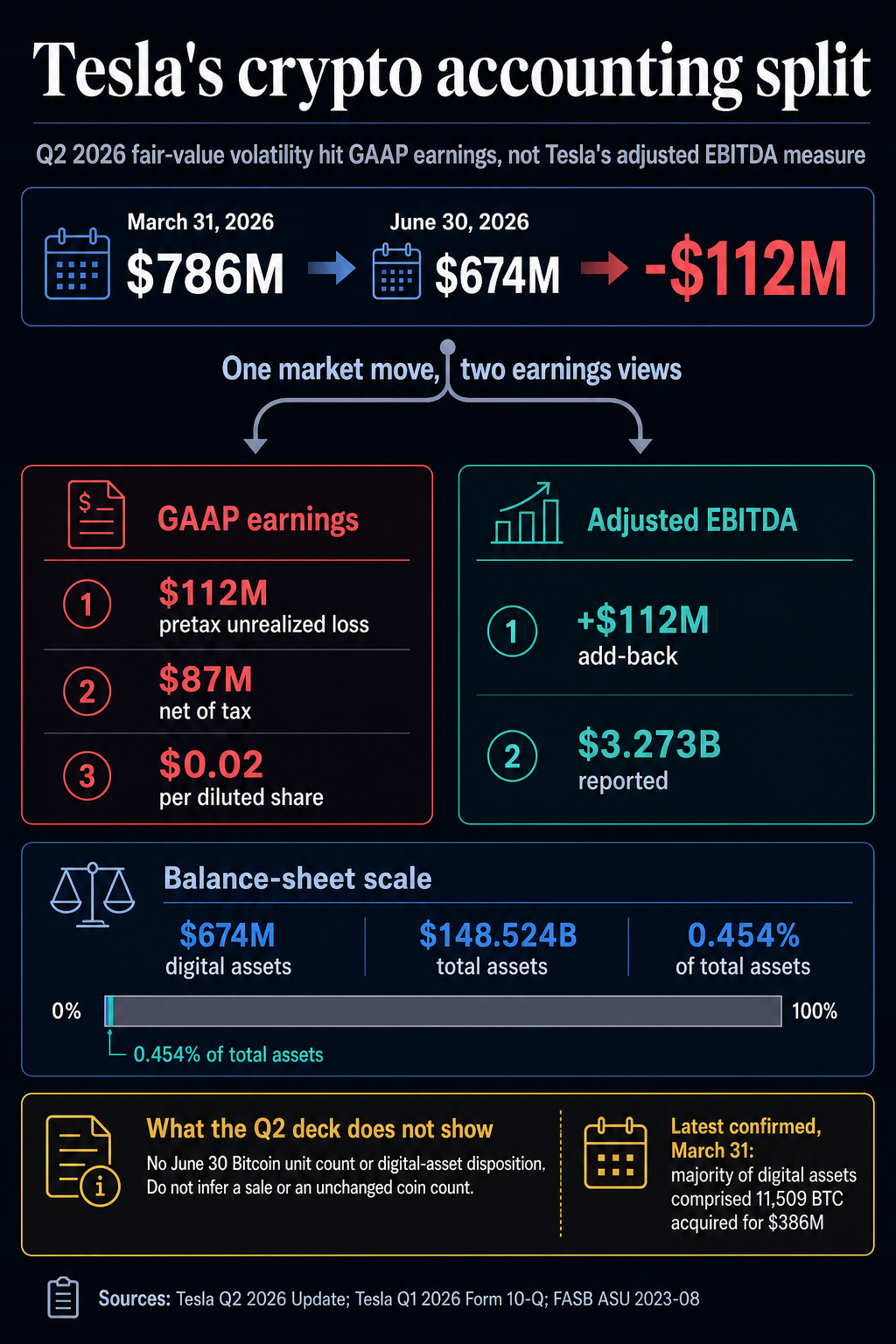
Tesla's March 31, 2026, filing reported that Bitcoin made up the majority of its digital assets, including 11,509 BTC acquired for $386 million.
The June 30 shareholder deck did not disclose a coin count or any digital-asset disposition, and Tesla's investor-relations page listed no Q2 Form 10-Q when checked on July 23, 2026.

Why the loss hit GAAP earnings
Under the Financial Accounting Standards Board's crypto-asset standard, covered holdings are measured at fair value each reporting period, with changes recognized in net income. That makes the earnings effect symmetrical: rising prices can generate an unrealized gain, while falling prices can produce an unrealized loss before any sale.
Tesla's preferred adjusted measure tells a different story. Its Q2 reconciliation added back the full $112 million digital-asset loss when calculating adjusted EBITDA of $3.273 billion.
The paper loss dragged down Tesla’s GAAP earnings but left adjusted EBITDA untouched. It also did not take cash out of the business.

The difference reshapes how Tesla’s earnings look on paper, not its broader balance-sheet exposure.
The $674 million digital-asset balance represented about 0.454% of Tesla's $148.524 billion in total assets at quarter-end. Tesla is therefore not operating like a dedicated Bitcoin treasury company whose capital strategy centers on accumulating the asset, even though crypto volatility can still leave a visible mark on its reported profit.

The Q2 result also shows the reverse of Tesla's fourth-quarter 2024 fair-value benefit. CryptoSlate reported that the accounting treatment contributed a $600 million lift to GAAP net income in that earlier quarter.
If crypto markets keep swinging, Tesla’s reported earnings will swing with them. If Tesla continues the same reconciliation treatment, those swings may again be excluded from adjusted EBITDA.
The next primary filing will be important for any updated Bitcoin unit count or transaction disclosure.
Until then, the change in carrying value establishes the accounting impact, not whether Tesla changed the size of its position.
The post Tesla books $112 million crypto paper loss as digital assets fall to $674 million appeared first on CryptoSlate.