

Michael Saylor has entered Bitcoin's BIP-110 fight with a 110-point case against a temporary soft fork that would restrict certain arbitrary-data and script uses.
His intervention lands while live monitoring shows 0.89% signaling and the current difficulty period is already mathematically unable to reach the proposal's early-lock threshold.
Editor’s Note: BIP-110 proposes a one-year Bitcoin soft fork that would temporarily restrict certain arbitrary-data and script uses at the consensus level. Supporters argue the limits would reduce data-storage abuse and protect node resources, while critics warn that its mandatory-signaling path and rejection of transactions currently valid under Bitcoin’s rules could set a dangerous consensus precedent and increase the risk of a chain split.
The executive chairman of Strategy, the largest corporate holder of Bitcoin, said he shares supporters' desire to protect the network but believes “the proposed cure is more dangerous than the condition.”
His case favors neutral base-layer rules, hard consensus, open markets, and permissionless innovation. In an earlier post, he warned about the precedent of invalidating currently valid, fee-paying transactions.
Saylor's institutional weight raises the dispute's profile, but it gives him no special authority over Bitcoin consensus. What matters next is whether miners, enforcing nodes, and economic actors coordinate before the proposal's fixed block heights arrive.
One final ordinary early-lock period remains
The monitor recorded 11 signaling blocks among 1,236 tracked at 06:07 UTC on July 20, leaving 780 blocks and requiring 1,098 more signals to reach the 1,109-block threshold. Even if every remaining block signaled, the period would finish with only 791 signals.
The next 2,016-block period, heights 959,616 through 961,631, is therefore the final full chance to lock in through the ordinary threshold. Under the canonical BIP, that requires 1,109 signaling blocks, about 55%.
If that period fails, enforcing nodes require bit 4 from heights 961,632 through 963,647 and reject blocks that omit it. From the July 20 monitor tip and nominal 10-minute blocks, the mandatory-signaling window would run roughly from Aug. 8 to Aug. 22. Forced lock-in occurs at height 963,648, followed by latest-path activation at 965,664, around Sept. 5. Actual dates will move with block production.
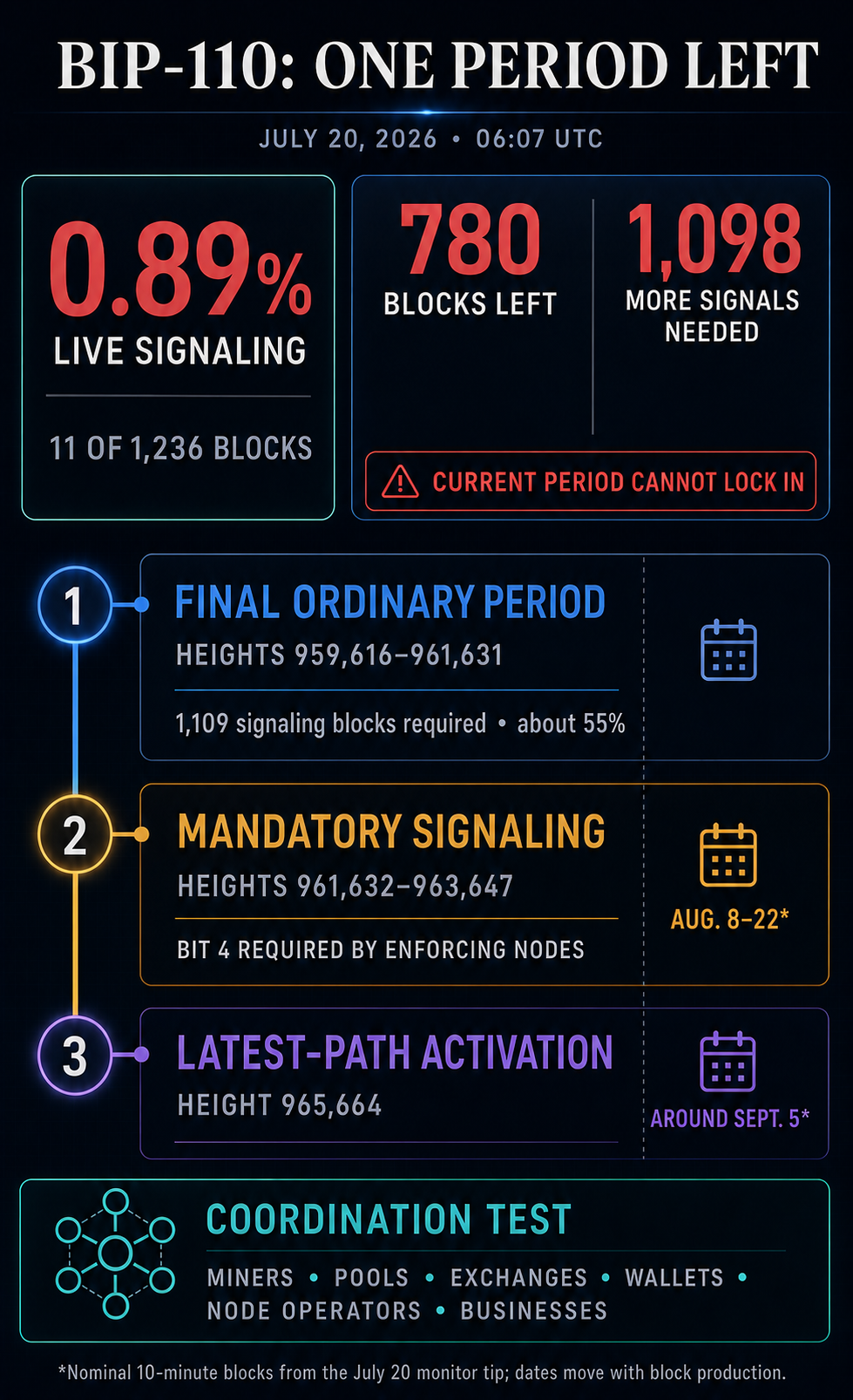

Without broad support from mining pools, Bitcoin could split into competing histories. Nodes enforcing BIP-110 may reject blocks that other nodes accept, leaving exchanges and businesses to choose which chain governs deposits, withdrawals, and confirmations.
Mining pools now face a choice over which chain to signal for. Wallet developers need to check for exposed Taproot and Miniscript paths, while node operators decide whether to enforce BIP-110.
A durable split is not inevitable because miners could coordinate, enforcement could remain limited, or economic actors could converge on one history. Non-signaling does not amount to rejection. The version bit shows visible support, not why a miner stayed silent.

BIP-110's temporary rules would last 52,416 blocks, about one year after activation, while exempting inputs that spend UTXOs created beforehand. CryptoSlate previously covered the broader fork risk and the July operator deadline.
Saylor's entry now raises the profile, but the decisive next signals remain identifiable pool support, enforcement choices, and concrete exchange or wallet readiness plans.
The post Saylor joins Bitcoin’s BIP-110 fight as miners get one last chance to avoid forced signaling appeared first on CryptoSlate.