Bitcoin fell over the past 24 hours as traders positioned for a Federal Reserve decision that could break a market pattern dating back more than three decades.
Data from CryptoSlate showed the largest cryptocurrency falling as much as 3% to $62,913, its lowest level in nearly two weeks, before recovering to $63,795 as of press time.
The weakness comes ahead of the Fed’s July policy meeting, only the second under Chairman Kevin Warsh.
The US central bank has kept its benchmark rate unchanged at 3.50% to 3.75% since December, while President Donald Trump has repeatedly pressed policymakers to lower borrowing costs.
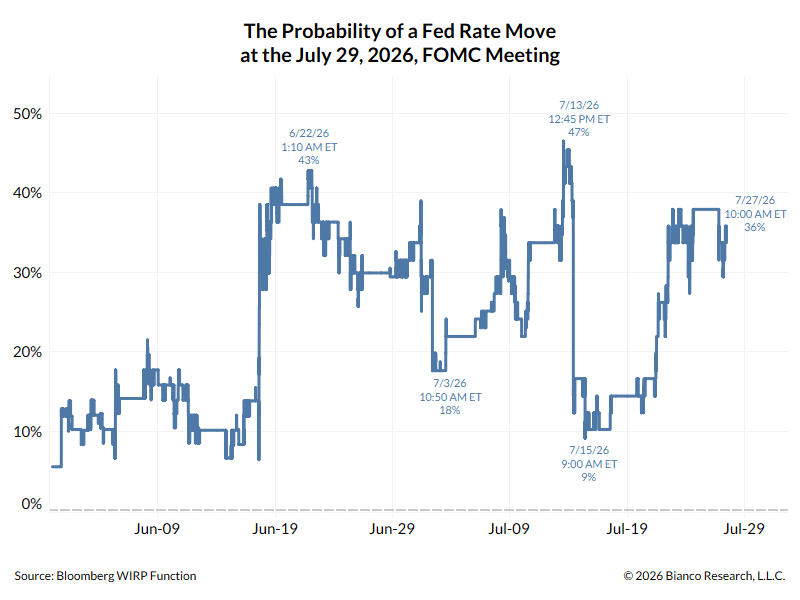
Still, investors largely expect policymakers to leave rates unchanged Wednesday. Futures markets assign roughly a one-in-three probability to a quarter-point increase, creating the potential for a sharper repricing across risk assets if the Fed opts to tighten.
Warsh’s no-guidance Fed makes the old playbook less reliable
Bank of America said the bigger risk lies in how little of a potential hike markets have priced before Wednesday’s decision.
The bank said the Fed has not raised rates since 1994 when markets had assigned less than a 60% probability to an increase beforehand. Futures currently embed only about 10 basis points of tightening, far short of the 25 basis points policymakers would deliver with a standard hike.
Block Scholes told CryptoSlate that the uncertainty is already historically unusual. The firm put the probability of a hike at 33.7%, with only two Fed meetings since 2015 showing markets this closely divided so near a decision.
The most recent came in September 2024, when traders were split between a 25- and 50-basis-point cut before the Fed ultimately chose the larger move.
That history, however, may be a less reliable guide under Warsh.
Jim Bianco, president of Bianco Research, argues that investors are still approaching the Fed through a framework built during an era when chairs typically guided markets toward likely decisions and forged broad committee consensus before meetings.
The Fed chair has rejected conventional forward guidance in favor of responding to incoming data and has said policymakers should have a “good family fight” over monetary policy before reaching decisions.
Bianco said that shift makes a 35% to 40% probability of a hike reasonable despite the limited tightening reflected in futures. He also argued that keeping rates unchanged Wednesday would not necessarily end the debate, with a larger increase potentially under consideration in September.
Trump drew attention to those internal divisions Monday, praising Warsh as “fantastic” and saying the Fed chair “wants to do the right thing,” while criticizing other policymakers for resisting lower rates.
Trump’s comments offer little indication of how Warsh will vote Wednesday, but they underscore the unusually visible disagreement surrounding the committee’s next move.
Citadel Securities is positioned for the less expected result.
The firm forecasts a 25-basis-point increase, arguing that tightening would strengthen Warsh’s inflation-fighting credentials while demonstrating that the Fed does not need to prepare markets for every policy move.
For Bitcoin, the greater risk may come from what investors conclude about the meetings that follow.
Bank of America estimates that a July hike could push the amount of tightening priced for 2026 from roughly 45 basis points to around 60 basis points.
That would turn Wednesday’s surprise from a single rate increase into a broader reassessment of how restrictive monetary policy could become this year.
Bitcoin’s resilience complicates the hike trade
Bitcoin would enter any rate-driven repricing after showing signs of weaker marginal demand but comparatively strong price performance.
US-listed spot Bitcoin exchange-traded funds recorded about $477 million of net outflows over the past three trading sessions, according to SoSoValue, marking a sharp reversal in ETF demand heading into the Fed decision.
Santiment data shows that crypto-market anxiety has also intensified around the meeting. Social discussion around rate hikes surged ahead of Warsh’s first FOMC decision in June, even though policymakers ultimately kept the benchmark rate unchanged.
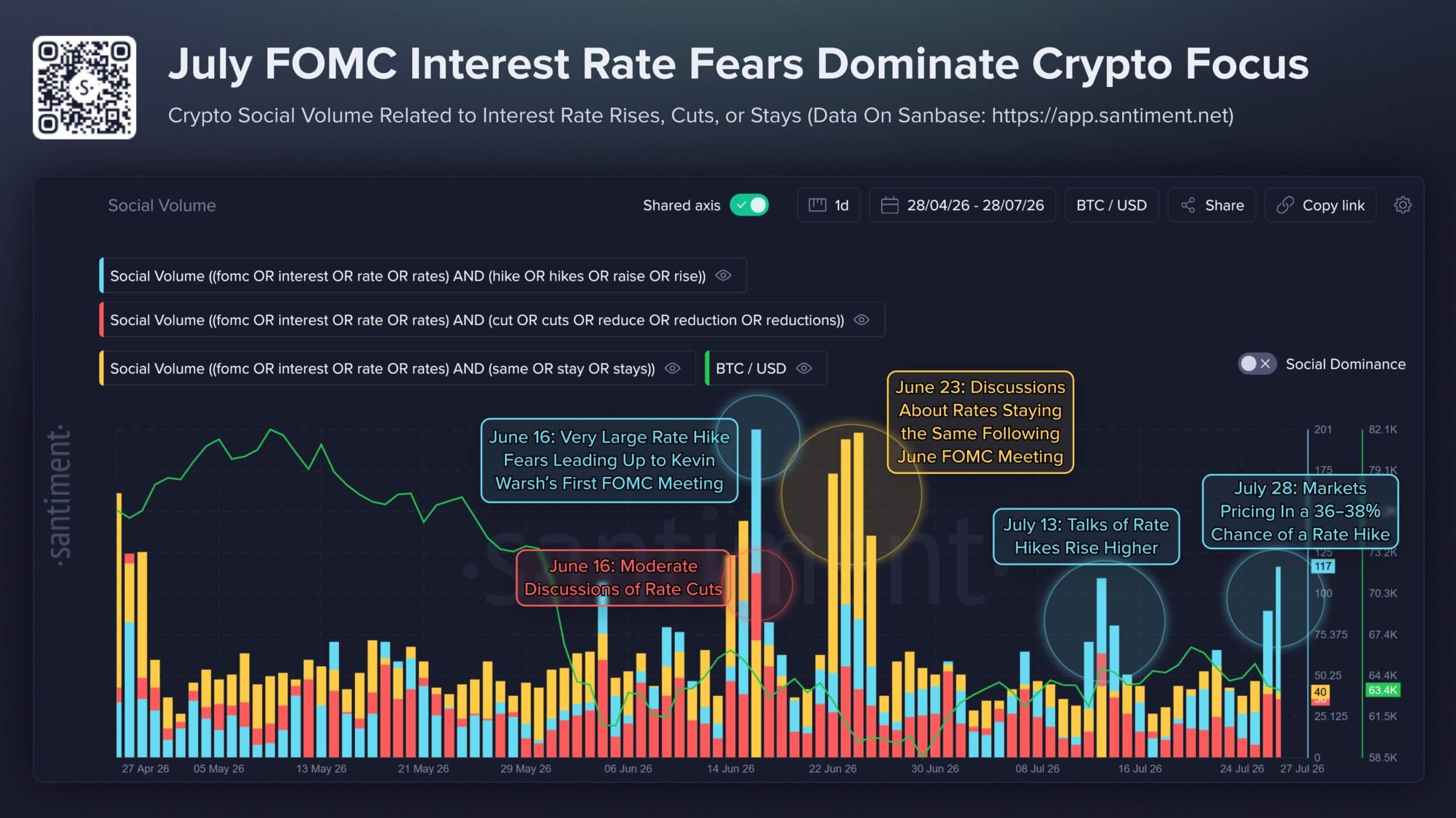
The analytics firm said chatter around hikes, cuts and unchanged rates has risen again ahead of Wednesday’s decision, reflecting growing attention to an outcome that remains unusually difficult for traders to price.
Bitcoin has nevertheless shown resilience this month despite the uncertainty, rising by roughly 9%. Block Scholes noted that the S&P 500 was broadly unchanged over the same period, while the firm’s basket of semiconductor and chip stocks had fallen almost 20%.
That relative strength has persisted despite the hawkish shift in rate expectations, renewed geopolitical tensions and an oil shock that briefly pushed crude above $100 a barrel.
The divergence complicates the assumption that a Fed increase would automatically produce a sustained Bitcoin selloff.
The market’s response may depend less on the quarter-point move itself than on how unexpected it is and whether policymakers present it as a one-off response to inflation or the beginning of a broader tightening cycle.
A hike could eventually create its own limits
Meanwhile, a more aggressive tightening cycle could eventually create a different risk for the Fed by weakening financial conditions enough to limit how far policymakers can go.
Marc des Ligneris, senior portfolio manager at CoinShares, told CryptoSlate that investors have become accustomed to a “Fed put.” This is the expectation that policymakers eventually respond when deteriorating financial conditions threaten broader market stability.
He said an initially hawkish shift could therefore become self-limiting if tighter rates trigger a deeper market unwind, with any eventual pivot toward easier policy potentially benefiting Bitcoin and gold.
That remains a conditional scenario. A quarter-point increase on Wednesday would neither imply that financial stress is imminent nor indicate that policymakers are preparing to reverse course.
The more immediate question for Bitcoin is what this decision tells investors about the policy path ahead.
A hold would preserve the market’s base case while shifting attention toward Warsh’s assessment of what could justify tightening in September.
A hike, however, would break the three-decade market-pricing pattern identified by Bank of America and could force traders to price a more restrictive path through the rest of 2026.
That makes the signal around Wednesday’s decision potentially more consequential for Bitcoin than the 25-basis-point move itself.
The post Kevin Warsh’s no-guidance Fed breaks a 30-year playbook – leaving Bitcoin vulnerable to surprise rate hike appeared first on CryptoSlate.