
Core Scientific, a longtime Bitcoin miner now converting sites for AI computing, reported a negative 56% self-mining gross margin in the second quarter as its colocation business generated sharply higher profit.
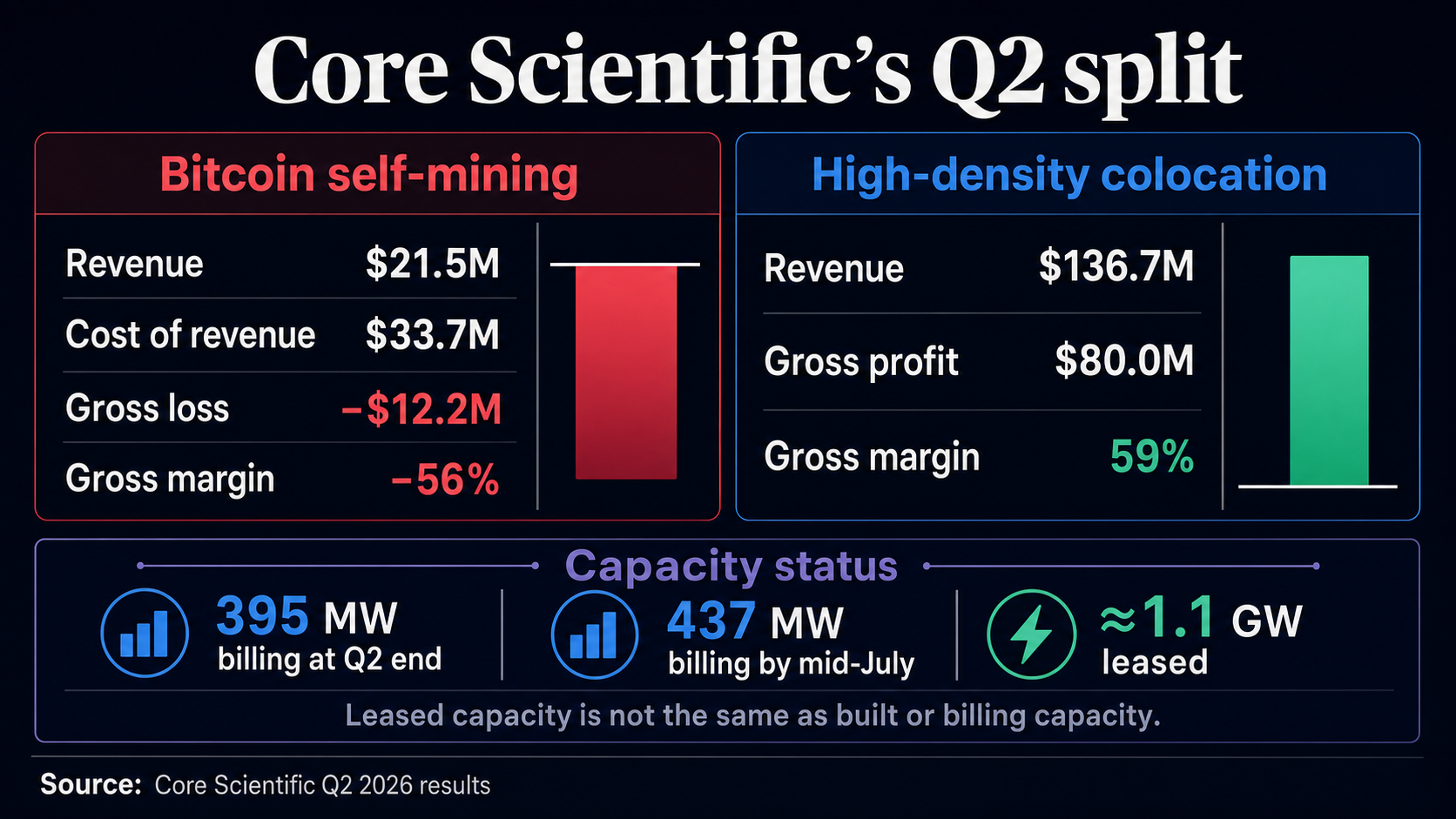
The company’s Q2 results show self-mining generated $21.5 million of revenue against $33.7 million of cost of revenue. That left a $12.2 million segment gross loss for the three months ended June 30.
High-density colocation, which provides powered data-center capacity for AI customers, moved in the opposite direction. The segment produced $136.7 million of revenue and $80.0 million of gross profit at a 59% margin. That gross profit exceeded Core Scientific’s $70.0 million consolidated total because mining and other segment losses pulled the companywide figure lower.
The mining result is not a disclosed spot-Bitcoin breakeven or a cash-production-cost estimate. Cost of revenue included $17.9 million of power fees, $9.9 million of depreciation and other operating expenses, so the margin cannot be reduced to the price at which the machines cover electricity alone.
Core Scientific says it is repurposing its remaining mining facilities for high-density colocation “as circumstances allow.” The Q2 loss strengthens the economic case for that strategy, but the company did not identify the quarter as its trigger or say that conversion had become compulsory.

According to the Investing.com transcript of Core Scientific’s earnings call, CFO Jim Nygaard said the company was operating mining primarily to offset contractual power costs during the wind-down. He said Core Scientific ended June with nearly 30% fewer miners online than at the end of the first quarter and was self-mining at only two sites.
The contract pipeline is larger than billing capacity
Core Scientific reported 395 megawatts of billing colocation capacity at quarter-end and 437 MW by mid-July. The later figure represented approximately $635 million in average annualized colocation GAAP revenue.
That operational footprint remains well below the roughly 1.1 gigawatts of leased customer power capacity tied to more than $24 billion of potential contracted revenue. The AMD relationship is anchored by 15-year agreements covering about 530 MW across five sites and more than $14 billion of potential base contracted revenue. A broader relationship could support up to 2.5 GW, but that figure is prospective, not built or billing capacity.
The gap shows how much of Core Scientific’s AI story still depends on conversion and delivery. It does not reveal how much mining power remains or when the last mining facilities could change use: neither the earnings release nor the attributed transcript quantified the two-site footprint in megawatts or supplied a complete conversion timetable.
Core Scientific’s $1.16 billion net loss also overstates the quarter’s operating damage because it was primarily driven by a $1.05 billion fair-value expense for warrants and contingent value rights as the stock price rose.
The quarter therefore stops short of proving that AI conversion is forced. It does show why mining is losing its claim on the company’s power and sites: one segment produced a negative gross margin while the other generated more gross profit than Core Scientific recorded in total.
The post Core Scientific lost 56% on Bitcoin mining but $80M in profit from its pivot to AI hosting appeared first on CryptoSlate.