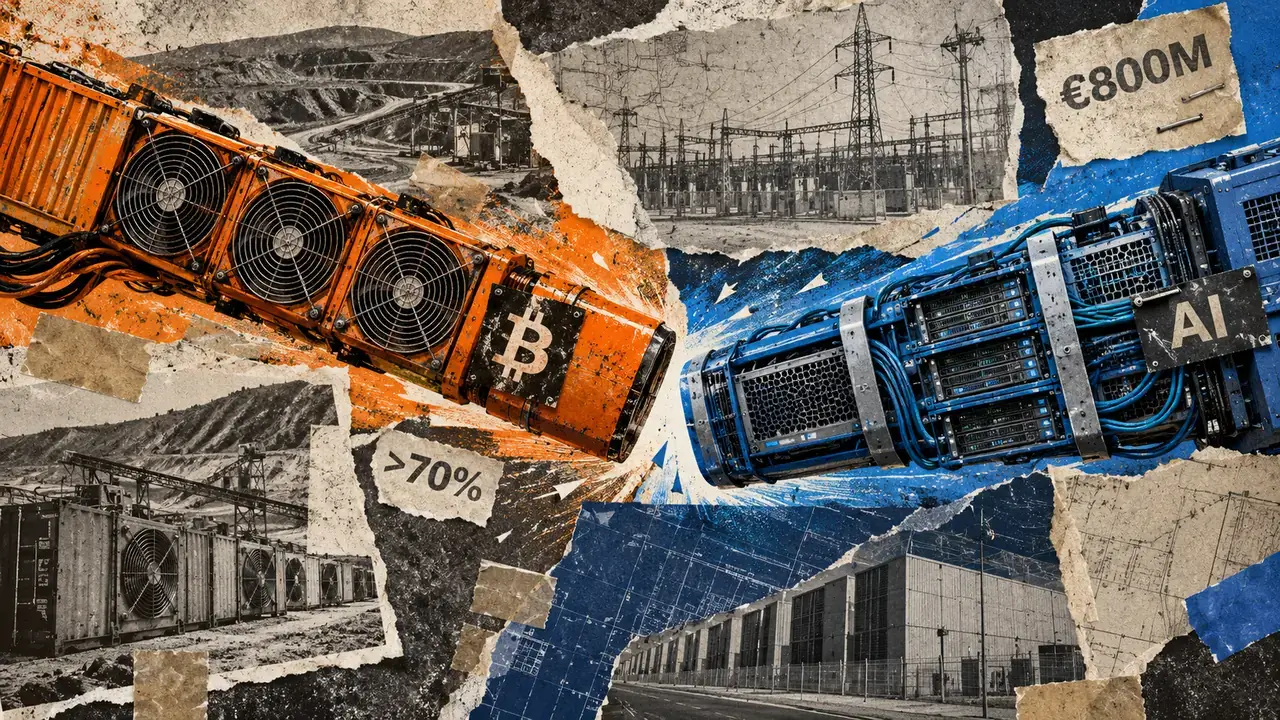
SWI Group has raised €800 million to expand AI infrastructure, advancing its plan to repurpose FTX-backed Bitcoin miner Genesis Digital Assets.
On Oct. 12, the Amsterdam-listed company announced a capital increase backed by institutional investors, valuing the group at €6.1 billion and bringing total equity raised since March above €1 billion.
The financing will support data-center development, power infrastructure and computing deployments across Europe and the United States, where SWI is converting its digital infrastructure portfolio toward artificial intelligence and high-performance computing.
The expansion includes Genesis Digital Assets (GDA), a former major investment of bankrupt crypto exchange FTX's trading affiliate, Alameda Research, which SWI acquired control of earlier this year.
The fundraising comes as Bitcoin miners increasingly redirect capital toward AI infrastructure, attracted by stronger projected profitability and rising valuations for companies with access to electricity and data-center capacity.
Former FTX investment becomes foundation for AI expansion
Genesis was among Alameda Research's largest venture investments before FTX collapsed in November 2022.
The trading firm invested approximately $1.15 billion in Genesis between 2021 and 2022, when the miner was valued at about $5.5 billion.
The investment later became the subject of bankruptcy litigation, with FTX's recovery trust seeking to reclaim funds it alleged Alameda improperly transferred. The trust dismissed the lawsuit in June 2026.
SWI has since consolidated control of Genesis, completing the acquisition of a stake exceeding 70% in August through share purchases and restructuring.
The company plans to rename the miner SWI Digital and use its US mining infrastructure as a foundation for high-performance computing and AI services.
Genesis's existing power-connected sites are central to that strategy, giving SWI access to infrastructure it can redevelop for more demanding computing workloads.
SWI previously disclosed that its combined European and American digital infrastructure portfolio exceeded 4 gigawatts of power capacity, with more than 80% of its capital allocated to the sector.
The group also plans to develop its own AI cloud platform, extending its business beyond data-center ownership into computing services for enterprises and developers.
SWI Chief Executive Max-Hervé George said the latest fundraising would help the company expand alongside growing demand for computing capacity.
The new shares will be issued in several series, although SWI did not identify the participating investors or disclose how much of the proceeds would be allocated specifically to Genesis.
Bitcoin miners' AI pivot delivers stronger returns
SWI's expansion follows a sharp divergence in the financial outlook for Bitcoin mining and AI infrastructure.
According to CoinShares' second-quarter mining report, AI computing infrastructure could generate approximately $1.5 million in annualized profit per megawatt, compared with an estimated $500,000 from Bitcoin mining.
That threefold difference has helped drive a substantial revaluation of former mining companies pursuing AI opportunities.
CoinShares found that 10 of the 12 publicly traded mining companies it tracked gained between 70% and 195% during the second quarter.
Companies focused on AI infrastructure, including Hut 8, Cipher Mining, TeraWulf and Core Scientific, traded at an average of 19.4 times forward sales, compared with 6.6 times for a group of more mining-focused competitors.
The shift reflects growing investor demand for companies with existing electricity connections and infrastructure capable of supporting AI workloads.
However, converting those assets remains capital-intensive.
CoinShares estimates that developing AI-grade facilities from mining infrastructure can cost $8 million to $15 million per megawatt, compared with approximately $700,000 to $1 million for mining infrastructure.
The report also found that more than $100 billion in disclosed AI computing contracts across the covered companies supported only about $1.1 billion in annualized revenue, with roughly 550 megawatts generating billings against more than 4 gigawatts of contracted capacity.
That gap has made project execution increasingly important as investors assign higher valuations to companies transitioning away from Bitcoin mining.
SWI's €800 million capital increase provides additional financing for its expansion, but the company has not disclosed which Genesis facilities will be converted first, their development costs or when they will begin generating AI computing revenue.
The post FTX’s former Bitcoin mining bet gets new life as parent raises €800 million for AI appeared first on CryptoSlate.