

Newly released Federal Reserve data show domestic hedge funds expanded their gross balance sheets during the second quarter, months before the central bank’s September rate decision.
The potential risk to Bitcoin is indirect. A policy surprise could raise funding or collateral demands across leveraged portfolios, forcing funds to find cash in liquid markets.
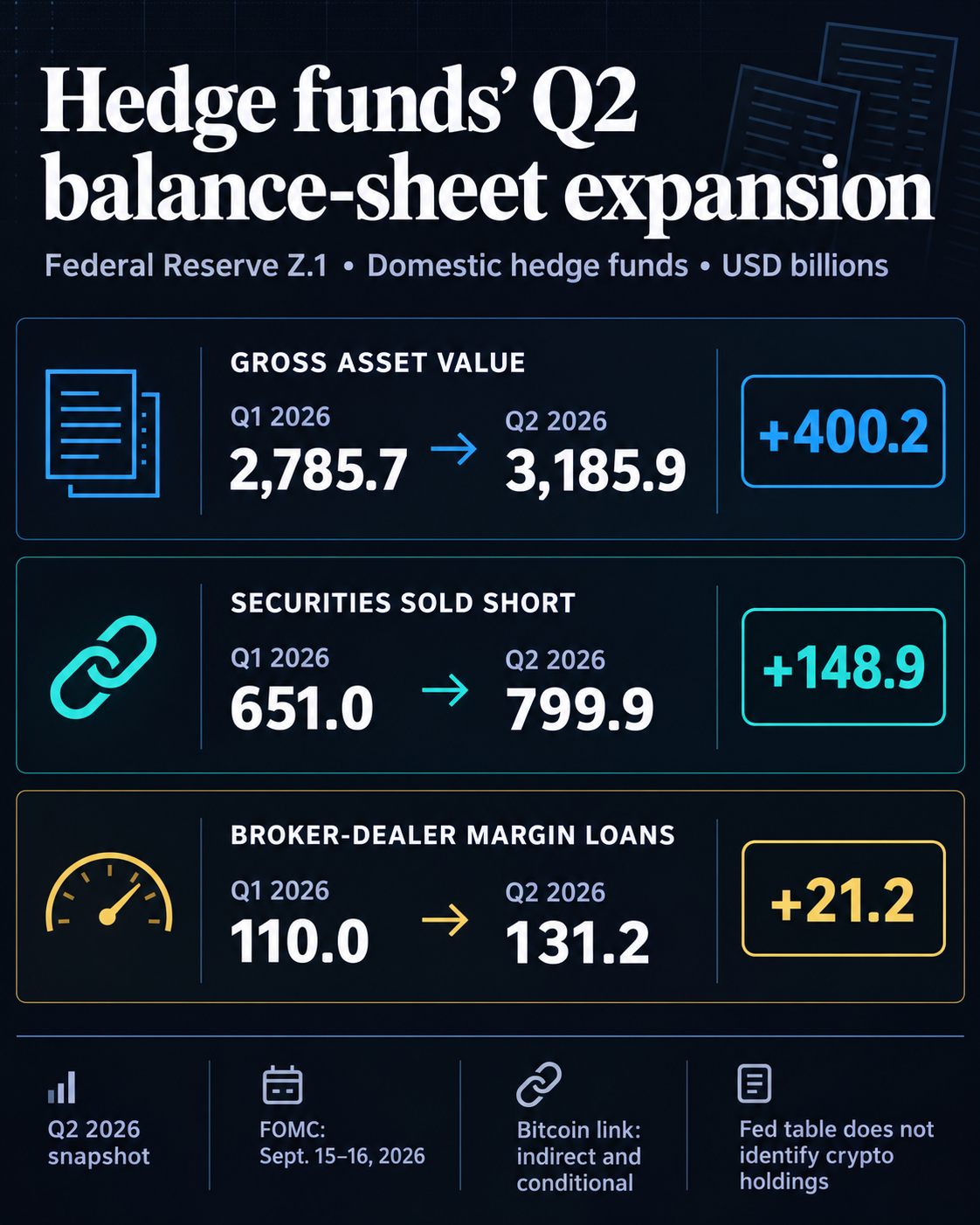
Gross asset value was $2.7857 trillion in the first quarter. It reached $3.1859 trillion in the second quarter. That was a $400 billion increase. The table defines gross asset value as total assets, not gross notional exposure.
Securities sold short stood at $651 billion in the first quarter. The total reached $799 billion in the second quarter. That marked a $148 billion rise.
Margin loans due to U.S. security brokers and dealers were $110 billion in the first quarter. They reached $131 billion in the second quarter. That was a $21 billion increase.
The Bitcoin spillover test
The FOMC is scheduled to meet Sept. 15–16, 2026, at a gathering associated with its Summary of Economic Projections. A surprise in rates or the policy outlook could reprice Treasury positions and the collateral that finances them.
The leverage backdrop raises the stakes. The Fed’s May Financial Stability Report said comprehensive Form PF data through the third quarter of 2025 put hedge-fund leverage at or near all-time highs. A separate Fed study estimated large qualifying funds had $4 trillion of gross Treasury exposure and $3 trillion of repo cash borrowing in September 2025. Those measurements cover different fund populations and cannot be added to the latest Z.1 figures.
Repo is short-term borrowing backed by securities. Dallas Fed research links hedge-fund net repo demand to constraints on dealers and other cash providers, as well as wider secured funding spreads. BIS research shows how higher margin requirements can force leveraged traders to post cash or unwind positions.
New York Fed data for Sept. 10 put the Secured Overnight Financing Rate, a broad measure of overnight Treasury-backed borrowing costs, at 3.62%. That latest snapshot alone does not establish a funding spike.
A Bitcoin spillover would become more credible if the Fed window brings tighter secured funding, a wider gap between related Treasury cash and futures prices, higher margin demands and visible selling across risk assets. Stable funding and no cross-asset liquidation would weaken the case. Until those signals appear, the Q2 data show amplification capacity rather than an actual Bitcoin sale.
The post Fed data shows hedge funds added $400 billion before Bitcoin’s September rate test appeared first on CryptoSlate.