

Washington just gave crypto one of its clearest policy wins of 2026. Bitcoin ETF demand cracked anyway.
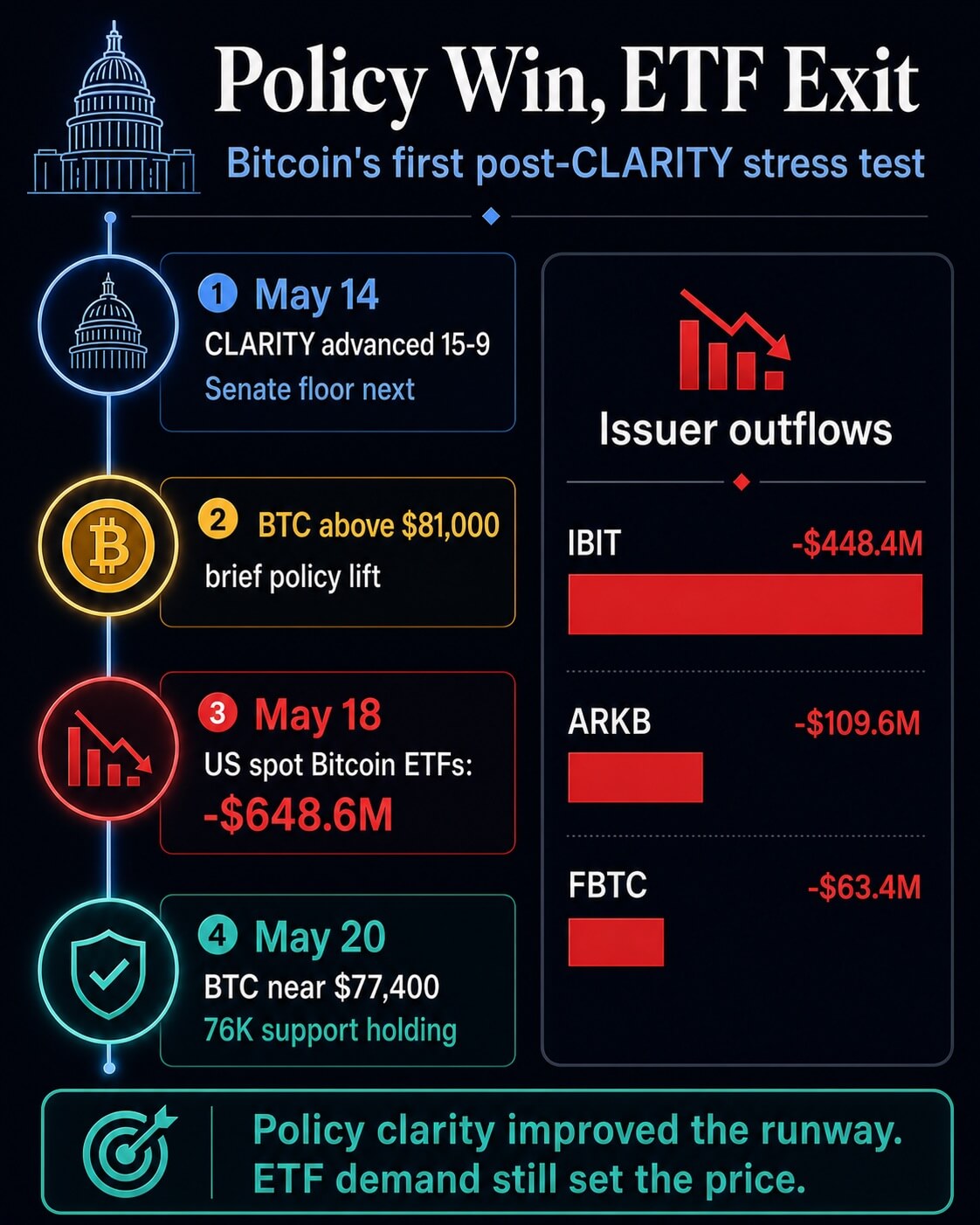
The Senate Banking Committee advanced H.R. 3633, the Digital Asset Market Clarity Act, by a 15-9 vote on May 14, sending the market-structure bill toward the Senate floor.
CryptoSlate reported that Bitcoin moved back above $81,000 after the vote, a clean headline for bulls who have argued that legal clarity would pull more capital toward digital assets.
By May 21, CryptoSlate's Bitcoin market data shows BTC around $77,200 after it recovered from the $76,000 area tested on May 18 and May 19.
That rebound keeps support alive while leaving the listed product exit intact. The contrast is telling: regulation can improve crypto's long-term runway, while ETF allocators still need a reason to add exposure during a risk-off week.
That makes the post-CLARITY move look less like a simple rejection of the bill and more like a stress test for Bitcoin's ETF-era market structure. The policy signal was real. The buying behind it proved too thin to absorb a sudden exit from listed products.

Policy clarity met a flow problem
The CLARITY Act vote was a substantive procedural milestone. The committee said the bill would establish a market-structure framework for digital assets and move to the Senate floor after the bipartisan vote.
Senator Mike Crapo's office separately confirmed the same 15-9 approval, reinforcing that the industry had a real legislative event to trade around.
Still, Washington's market-structure push had been visible for months. The House passed H.R. 3633 in July 2025, according to Congress.gov, and the Senate Agriculture Committee advanced related digital commodity legislation in January 2026.
May 14 was an important acceleration, and it arrived after a longer policy build-up rather than out of a blank calendar.
That setup raises the old market question: did investors buy the rumor and sell the news? For this event, the answer has to stay conditional. Bitcoin got a brief policy lift, then the follow-through faded once ETF flows, inflation pressure, and positioning moved back to the center of the trade.
A policy headline can change the industry narrative. The marginal buyer still has to arrive before it can defend spot price. That makes institutional Bitcoin demand the next confirmation signal, rather than the policy vote itself.
The clearest evidence came from the same channel that has carried much of Bitcoin's institutional story: US spot Bitcoin ETF products. Farside data shows the products posted $648.6 million in net outflows on May 18 alone, with smaller outflows continuing on May 19 and 20.
BlackRock's IBIT accounted for $448.4 million of that exit, followed by $109.6 million from ARKB and $63.4 million from FBTC.
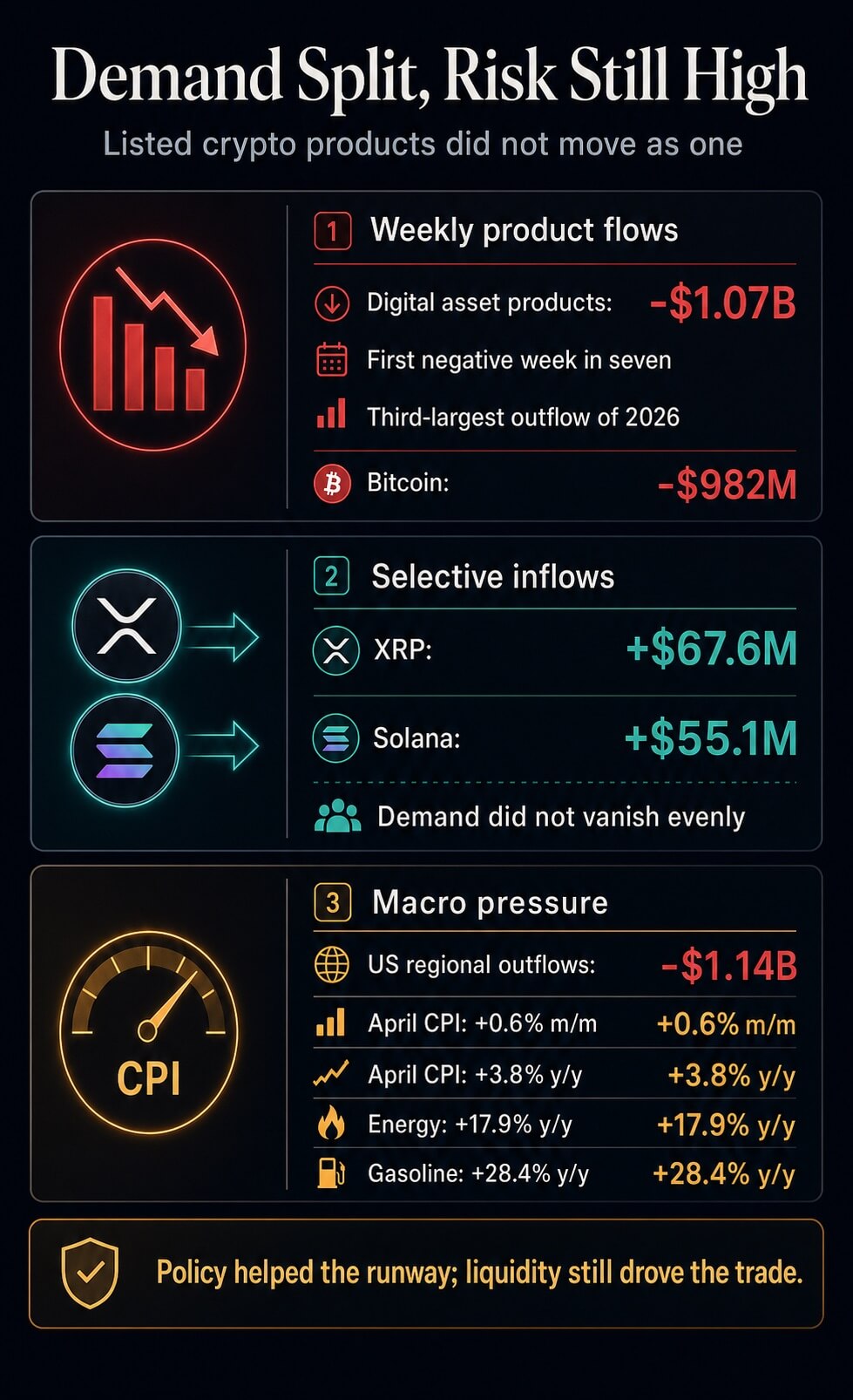
CoinShares widened the pressure beyond one ETF table. Its May 18 fund-flow report showed $1.07 billion of digital asset investment product outflows, the first negative week in seven and the third-largest weekly outflow of 2026.
Bitcoin accounted for $982 million of those withdrawals.
That undercuts the clean policy-rally narrative. If CLARITY had created fresh, immediate institutional demand for Bitcoin, the ETF channel should have been where that demand appeared.
Instead, the biggest listed product market became the source of pressure. The result was a test of spot Bitcoin ETF outflows that mattered more to price than the policy headline itself.

| Signal | What changed | Market implication |
|---|---|---|
| Senate Banking vote | CLARITY advanced 15-9 on May 14 | Policy momentum improved; full Senate passage and enactment are still ahead |
| Spot Bitcoin ETFs | $648.6 million of net outflows on May 18 | ETF-led BTC demand failed its first post-vote stress test |
| Digital asset products | $1.07 billion of weekly outflows, with BTC at $982 million | The pressure extended beyond a single issuer or one trading day |
| Other assets | XRP and Solana products saw $67.6 million and $55.1 million of inflows | Listed-product demand stayed selective across crypto |
The US also drove the regional pressure. CoinShares reported $1.14 billion of US outflows, while Switzerland, Germany, the Netherlands, and Canada still saw inflows.
That split is important because Bitcoin's current institutional thesis is heavily tied to US-listed ETF access. When the US channel sells, Bitcoin feels it first.

Selective inflows complicated the selloff
The outflow week was selective. CoinShares reported XRP inflows of $67.6 million and Solana inflows of $55.1 million, a useful counterweight to any claim that listed-product investors abandoned the entire asset class.
The better takeaway is selective exposure rather than a durable altcoin rotation. Bitcoin was the main funding source in listed products at the same moment the industry received a policy headline that bulls might have expected to help BTC first.
The policy angle may land differently across assets. Market-structure clarity can be more directly relevant to tokens whose US regulatory treatment, exchange access, or product pipeline remains a live question.
Bitcoin already sits at the center of the ETF channel that just became the pressure point. For BTC, the CLARITY vote was supportive more than transformational.
That leaves Bitcoin trading on the variables that still dominate large allocators: inflation, yields, liquidity, leverage, and ETF demand.
The April CPI release from the Bureau of Labor Statistics showed consumer prices rising 0.6% in April and 3.8% from a year earlier, with energy up 17.9% year over year and gasoline up 28.4%.
Those numbers kept macro pressure alive before the ETF reversal hit.
Recent CryptoSlate coverage already tied the Bitcoin decline to that mix. US spot Bitcoin ETFs had lost about $1 billion, or roughly 14,000 BTC, as a six-week inflow streak ended on inflation fears.
Separate market coverage pointed to leverage, options hedging, and the break below $78,000 as reasons the post-vote move failed to hold.
In that setup, CLARITY kept its importance. Liquidity simply outranked it in the short term.

The result is a cleaner version of the sell-the-news frame. The May 14 vote improved the policy backdrop, while the May 18 flow data showed allocator demand remained conditional.
Bitcoin did receive a policy lift, and the listed-product channel turned into the pressure point before that lift could become durable demand.
Flows set the next test
Bitcoin ETF flows now set a more direct test than the first post-vote price reaction. If ETF flows stabilize while CLARITY moves toward a floor vote, the May 18 outflow would look like a reset after six weeks of inflows.
With BTC around $77,400 after bouncing from the $76,000 area twice, Bitcoin still needs to turn support into follow-through and work back toward $78,000-$80,000.
If outflows continue, the market signal shifts. Sustained Bitcoin ETF selling would show that legal clarity has yet to translate into fresh spot demand, and suggest that Bitcoin's marginal buyer is pulling back even as Washington improves the legal backdrop for crypto.
That would make the CLARITY milestone a long-term industry positive and a poor short-term shield for BTC price.
That contradiction is the useful signal. Crypto policy is moving in the direction the industry wanted, while Bitcoin's price is still being set by whether large holders and ETF allocators are willing to pay up now.
The Senate vote improved the legal runway. The May 18 flows showed the runway has limited value when the marginal buyer steps away before price can recover.
The post Bitcoin ETF demand weakens despite CLARITY Act policy win appeared first on CryptoSlate.