

The Bank of England’s proposed cap on stablecoin holdings faces mounting resistance from across the crypto industry. UK founders, global CEOs, and politicians warn that the restrictions could cripple payments, block business growth, and drive talent offshore.
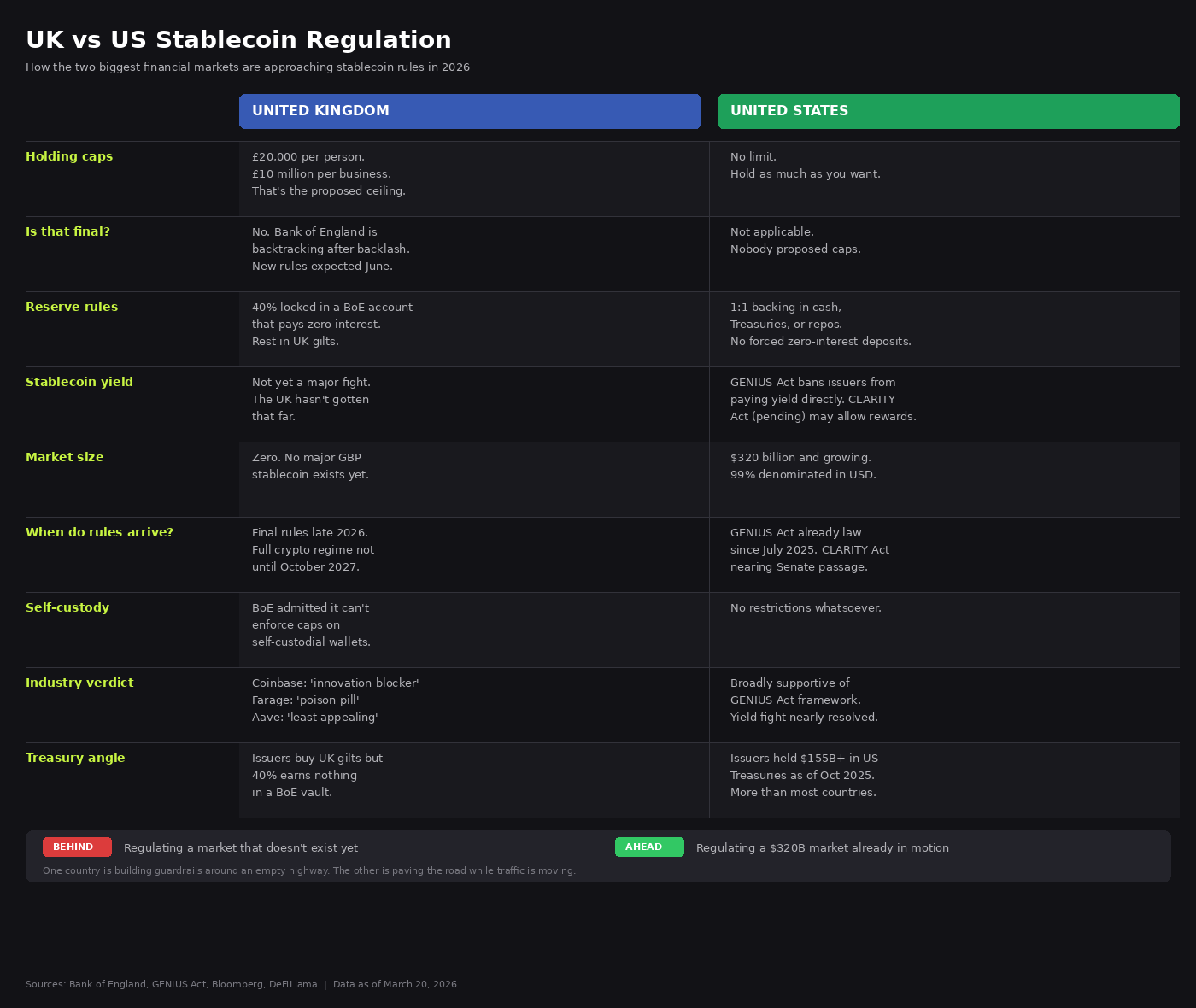
The proposal, introduced in a November 2025 consultation paper, would impose temporary limits of £20,000 per individual and £10 million per business on holdings of sterling-denominated systemic stablecoins. No other major jurisdiction has proposed equivalent caps.
Why the Bank of England Wants a Cap
The central bank designed the limits as a transitional safeguard against deposit flight. If large-scale sterling stablecoins launch without restrictions, officials fear customers could quickly move savings from traditional bank accounts into digital tokens.
That shift could disrupt lending and credit availability in an economy where banks supply roughly 85% of consumer borrowing.
The proposal also requires systemic stablecoin issuers to hold 40% of reserves in unremunerated Bank of England accounts, a condition that could significantly reduce issuer revenue since most earn interest on short-term Treasury holdings.
Adriana Ennab, UK Director at Stand With Crypto, outlined the Bank’s rationale to during a recent BeInCrypto Expert Council.
“The Bank of England is looking at a £20,000 cap for individuals and £10 million for businesses during the transition period, to protect financial stability and prevent large outflows,” said Adriana.
Why Founders Say It Won’t Work
Stand With Crypto convened roundtables with builders across the UK over several months. The feedback was consistent. Cross-border payments, supply chain transactions, and salary processing would all hit the ceiling quickly, particularly for mid-sized firms that operate well above £10 million in transaction volume but fall below enterprise thresholds.
“They told us their businesses would be impossible. Payments would be capped, transfers would be capped — and for many companies, £10 million simply wouldn’t be enough. Some founders told us they had already set up in the Isle of Man, and others said if they were starting today, they would build somewhere else,” Adriana explained.
The enforceability question adds another layer. Self-custodial wallets operate outside centralized platforms, making it technically difficult for regulators to monitor or enforce holding limits.
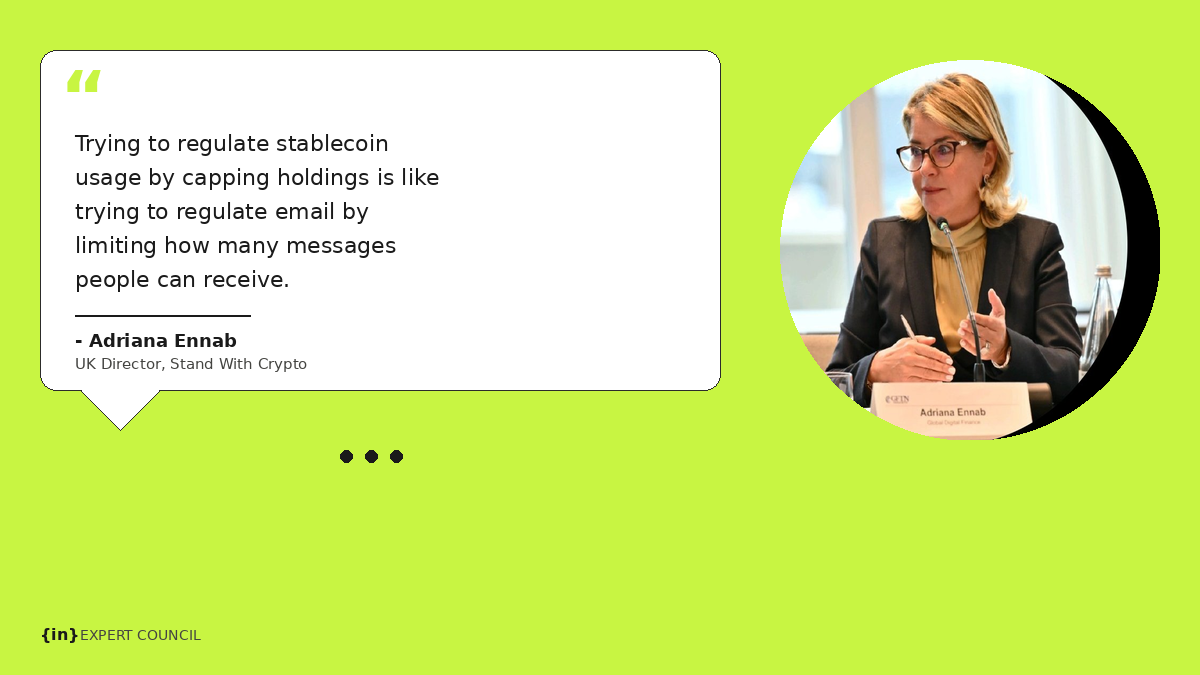
During the BeInCrypto Expert’s Council, Ennab compared the approach to a structural misunderstanding of the technology itself.
Freddie New, Director at Bitcoin Policy UK, raised a separate concern. Stablecoin reserves typically hold government debt, meaning issuers effectively become large-scale buyers of UK gilts.
He pointed to the US, where Tether has become one of the largest holders of American government debt, ranking ahead of several sovereign nations.
Restricting stablecoin growth could reduce demand for sovereign bonds at a time when governments need buyers.
“It’s very difficult to communicate to the Bank of England that having a guaranteed buyer of government debt is not necessarily a bad thing,” Freddie New told the Council.
The Backlash Goes Global
The criticism extends well beyond UK founders. Coinbase CEO Brian Armstrong called the caps an “innovation blocker” that risks preventing the UK from being globally competitive.
Likewise, Nigel Farage described the proposal as a “poison pill” for Britain’s financial sector. Elsewhere, Aave founder Stani Kulechov warned that the caps combined with reserve rules would make the UK the least appealing jurisdiction for stablecoin issuers.
Stand With Crypto’s own research reportedly found that as the US stablecoin market grew to $300 billion, bank deposits also increased.
The data suggests stablecoins function as an additional store of value rather than a replacement for traditional deposits, undermining the Bank of England’s core justification.
The political pressure is also building. Stand With Crypto’s petition against the caps collected 84,276 signatures before closing on March 3.
The House of Lords launched its own inquiry into stablecoins in late January, writing to every signatory and requesting evidence.
Farage’s Reform Party has pledged to cut capital gains tax on crypto to a flat 10%, adding electoral pressure on the ruling Labor Party to respond.
What Happens Next
Bank of England Deputy Governor Sarah Breeden told the House of Lords in March that the central bank is “genuinely open to other ways” of managing the risks.
She acknowledged technical difficulties in enforcing the caps and questioned whether building monitoring systems for temporary restrictions would be cost-effective.
Updated draft rules are expected in June, with final regulations planned by year-end. The UK’s broader crypto asset regime is not expected until October 2027.
With the EU advancing its 28th regime for streamlined cross-border business registration and the US already implementing the GENIUS Act and pushing the CLARITY Act toward passage, UK founders say the window for competitive policymaking is closing fast.
The talent exists. The question is whether the regulations will arrive in time to keep it onshore.
The post UK Stablecoin Cap Could “Make Businesses Unworkable,” Experts Say appeared first on BeInCrypto.