

Pi Network has activated its first smart contract on Testnet, bringing subscription functionality to the blockchain. The upgrade arrives as PI trades near $0.17, well below the key Fibonacci resistance that bulls want reclaimed.
The rollout introduces recurring-payment logic for e-commerce, streaming, and other services. Community sentiment has turned cautiously optimistic, yet the daily chart still shows a neutral structure after months of decline.
Subscription Smart Contracts Set a New Utility Floor for Pi
On April 17, 2026, Pi Network announced its first smart contract capability on Testnet. The release focuses on subscription support, a model most chains have struggled to deliver cleanly.
Subscribers can approve a defined budget that the contract draws from over a set billing horizon. Funds remain in the wallet until a charge is processed.
The design avoids the full pre-funding required by account abstraction standards like ERC-4337. It also removes repeat signatures used in earlier Ethereum proposals, such as EIP-1337. Pi frames this as a cleaner path for on-chain recurring payments.
Pi Request for Comment 2 (PiRC2) is now open for developer review on GitHub. External auditors are also reviewing the contract before any Mainnet rollout.
Community voices have mapped the release to real use cases. One post listed streaming, AI tools, digital memberships, e-commerce, and local commerce as targets. The list reflects a broader push to anchor Picoin demand to recurring real-world services rather than speculative activity.
The pitch to builders leans on scale. Pi claims more than 18 million KYC verified users, which boosters frame as a ready customer base.
Dr. Vincent McPhillip argued that smart contracts bring Pi functionality closer to Ethereum. He suggested the release could set the stage for a sustained move. The market, he added, is watching.
That optimism is tempered by warnings about staking, DeFi, and dApp risks in any young ecosystem. Education and external audits will shape how safely the rollout proceeds.
This contract remains in Testnet. A Mainnet launch will depend on audit outcomes and PiRC2 feedback, which sets the near-term expectation bar.

PI Price Coils Below $0.18 Fibonacci Resistance
PI trades at $0.1699 on Bitget, just below the 0.236 Fibonacci retracement at $0.1823. The Fib tool is anchored from the September 22, 2025, breakdown high of $0.3527. The lower anchor is the February 6, 2026 low of $0.1297.
The 0.236 level is the first lid PI must clear. A daily close above $0.1823 would open the path to the 0.382 retracement at $0.2149.
Beyond that sits the 0.618 retracement at $0.2675, a heavier supply zone defined by prior reaction highs. Reclaiming that band would mark the first serious break of the multi-month downtrend.
On the downside, horizontal support sits near $0.15. Losing it would expose the February low at $0.1297 and confirm another leg lower.
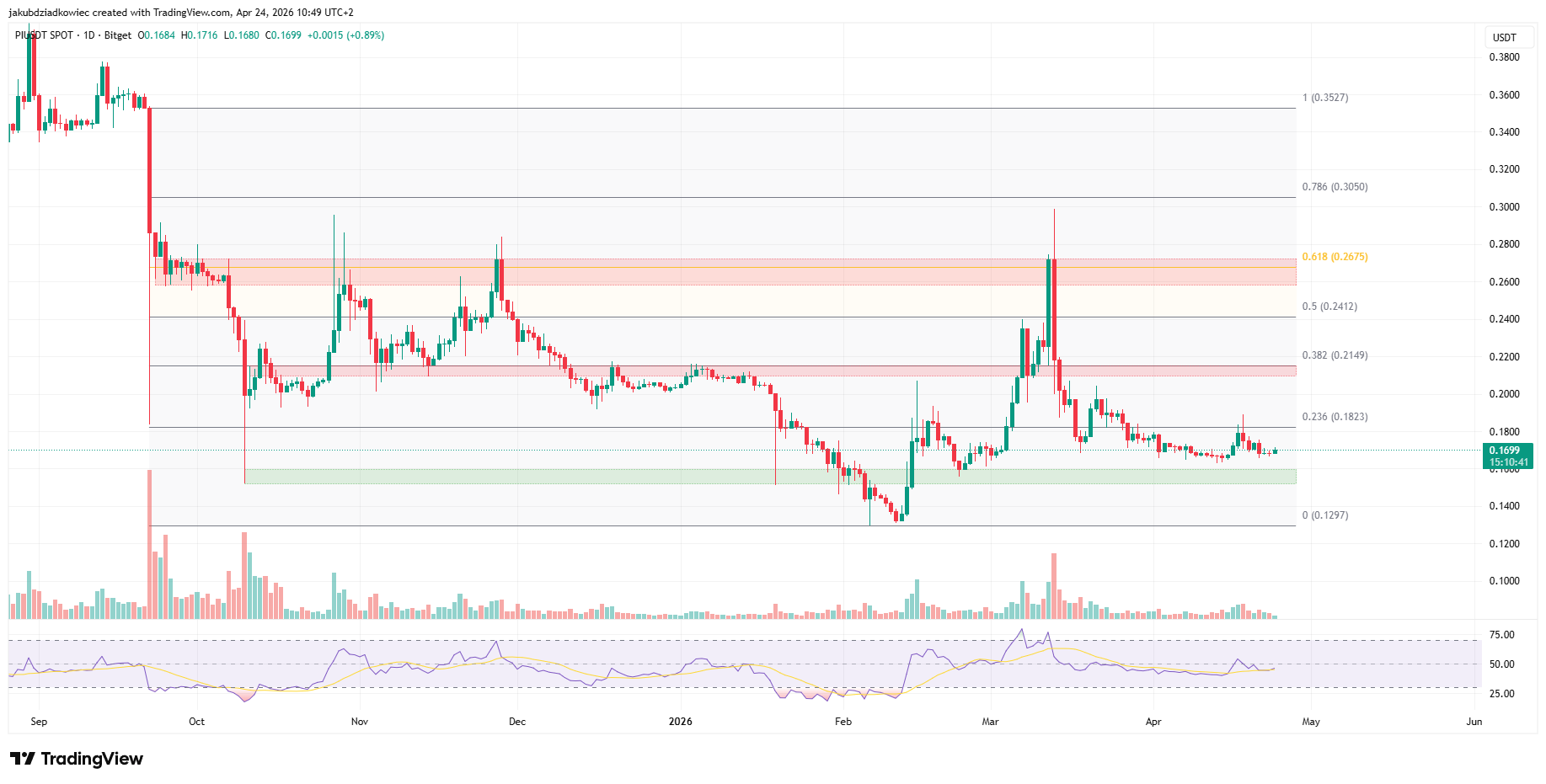
The Relative Strength Index (RSI) sits in the mid-40s. That reading indicates neutral momentum with no clear buying or selling pressure building.
Volume has thinned noticeably across April. Low turnover during a sustained decline often suggests accumulation, though it can also reflect fading interest. A fundamental catalyst, like a confirmed Mainnet date, would be the cleanest trigger for a volume expansion.
The subscription smart contract rollout is the fundamental catalyst that traders are pricing in. Whether it drives flows into PI will depend on Mainnet timing and Pioneer participation in Testnet review.
A break above $0.27 would flip the bias to bullish. It would also invalidate the descending structure that has capped every rally since late 2025. A close below $0.15 would confirm the bears still control the tape.
The post Pi Network Smart Contracts Go Live on Testnet, Can PI Break $0.27 Resistance? appeared first on BeInCrypto.