
Ripple is pursuing an Australian Financial Services License (AFSL) through its proposed acquisition of BC Payments Australia Pty Ltd, extending its reach into a key Asia-Pacific market.
While Ripple is expanding its institutional footprint, XRP (XRP) continues to attract notable retail demand as evidenced by exchange-traded fund (ETF) data and on-chain accumulation.
Australian License Marks Strategic APAC Expansion For Ripple
According to the company’s announcement, the proposed acquisition remains subject to finalizing the standard completion process. Ripple’s bid for the AFSL would allow it to offer regulated payment services to Australian banks, fintech firms, and enterprises.
“Australia is a key market for Ripple, and an AFSL strengthens our ability to scale Ripple Payments across the region. By leveraging blockchain technology and digital assets, we enable customers to move value globally with greater speed, transparency, and reliability. We remain focused on working closely with regulators to support the next phase of growth for digital asset infrastructure,” said Fiona Murray, Managing Director, Asia Pacific, Ripple.
The company already works with several Australian customers, including Hai Ha Money Transfer, Stables, Caleb & Brown, Flash Payments, and Independent Reserve. Its payment volume in the APAC region nearly doubled during 2025, reflecting strong demand.
Ripple also participates in local regulatory projects, including Project Acacia, an initiative of the Reserve Bank of Australia and the Digital Finance Cooperative Research Centre.
Follow us on X to get the latest news as it happens
Globally, Ripple now holds more than 75 regulatory licenses. The company highlighted that Ripple Payments has processed over $100 billion in transactions across more than 60 markets.
XRP ETFs Show Retail-Driven Demand Pattern
As Ripple’s expansion efforts continue, XRP is gaining retail appeal. Unlike Bitcoin (BTC), Ethereum (ETH), and Solana (SOL) ETFs, which attracted significant institutional capital, XRP ETFs appear to be more heavily driven by retail demand.
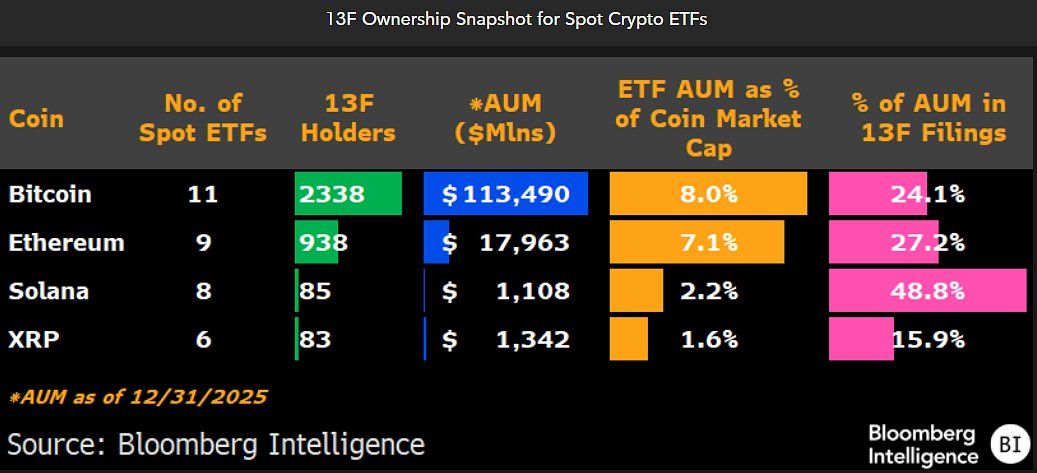
Recent data on cryptocurrency ETFs highlights differences between XRP ETFs and other digital asset funds. Data from Bloomberg Intelligence showed that as of December 31, 2025, XRP ETFs had $1.342 billion in assets under management, with just 15.9% owned by institutional investors filing Form 13F. In contrast, Bitcoin and Ethereum ETFs had higher institutional participation.
“The XRP ETFs have actually held up pretty well despite the massive pullback in price,” James Seyffart, senior research analyst at Bloomberg Intelligence, noted. “Who are these buyers/holders? Well, we only know a small portion of them because the vast majority don’t file 13Fs….XRP ETFs are heavily driven by retail demand.”
As of December 31, 2025, the 13F filers collectively held $213.4 million in XRP. The top three holders were Goldman Sachs Group with the largest position at $153.8 million (83.6 million XRP), followed by Millennium Management at $23 million (12.5 million XRP), and Logan Stone Capital in third with $5.3 million (2.9 million XRP).
Meanwhile, on-chain exchange data reinforces the retail demand for XRP. The number of XRP withdrawal transactions on Binance spiked several times in recent days, exceeding 14,000 transactions on March 6, according to on-chain analyst Darkfost.
A spike in XRP withdrawals suggests holders are moving tokens to private wallets, signaling accumulation and reduced sell-side pressure. This is generally seen as a bullish sign.
“This dynamic also occurs in a context of growing interest around XRP ETFs,” Darkfost wrote. “If this trend continues, XRP could keep attracting a portion of the available liquidity within the altcoin market, in an environment where capital remains selective and tends to concentrate on a limited number of assets.”
Two Tracks, One Token
Ripple’s institutional expansion and XRP’s retail momentum are running in parallel but remain independent for now. Institutions engaging with Ripple Payments are drawn to its compliance framework, transaction speed, and cross-border settlement capabilities. Retail investors, meanwhile, are responding to XRP’s ETF and price.
The question is whether these forces eventually converge. If Ripple’s growing payment network drives meaningful transaction volume through XRP, that could give retail holders a fundamental case beyond speculative positioning.
For now, however, the institutional side concerns Ripple’s platform, and the retail side concerns XRP’s market. Both are positive signals, just for different reasons and different audiences.
Subscribe to our YouTube channel to watch leaders and journalists provide expert insights
The post How Ripple and XRP Retail Investors Are Building Momentum on Parallel Tracks appeared first on BeInCrypto.