
New York-based activist short-selling firm Culper Research has disclosed that it is betting against Ethereum (ETH) and ETH-linked equities, including BitMine (BMNR).
The firm’s disclosure arrives amid significant fluctuations in Ethereum (ETH) this month, reflecting broader market volatility and testing investor conviction.
Why Culper Is Short on Ethereum
In a recent report titled “Ethereum (ETH USD): What Vitalik Knows, and Tom Lee Doesn’t,” Culper Research argued that the network’s December 2025 Fusaka upgrade has impaired the token’s economics.
“We are short Ether (ETH USD). We believe Ethereum’s December 2025 Fusaka upgrade has impaired ETH
tokenomics. Vitalik is selling, while bulls like Tom Lee are clueless as to ETH’s new reality. We’re with Vitalik,” the report read.
The report explained that the upgrade increased Ethereum’s Layer 1 gas limit from 45 to 60 million units, aiming to boost adoption. Vitalik Buterin and the “Pump the Gas” (PTG) initiative supported this move.
They estimated it would reduce transaction fees by 10-30% and increase Layer 1 activity, thereby strengthening Ethereum’s tokenomics. However, Culper claimed that the fees collapsed by about 90%
“Vitalik and validators miscalculated L1 demand elasticity by 3-9x based on outdated math (pre-EIP-1559 and pre-L2s),” it said.
Follow us on X to get the latest news as it happens
The firm mentioned that the increase in blockspace led to two major issues:
- The protocol faced “address poisoning,” which some bulls misinterpret as a sign of stronger fundamentals.
- Cupler added that blocks are now filled with low-value spam, so legitimate transactions no longer compete to be included.
“Validator fees and yields have collapsed, staking demand falls, and network security deteriorates in a reflexive loop that experts have long warned could emerge if blockspace expanded faster than real demand, which is exactly what has happened,” the report added.
BitMine also sits at the center of Culper’s short. The firm is the largest corporate holder of Ethereum, with $4.47 million ETH.
Culper stressed that BitMine defends its position by arguing that “ETH is not in a death spiral because utility is going up.” However, the firm pushed back on Tom Lee’s optimistic reading of Ethereum’s network activity.
“On-chain data from Jan 2025 through Feb 2026 reveals the ETH activity that Lee cites as ‘institutional adoption’ is, in reality, explained by a flood of low-value address poisoning / wallet dusting triggered by a glut of blockspace post-Fusaka,” Culper remarked. “Post-Fusaka: 95% of growth in new wallets is explained by newly-created ‘dusting’ wallets; poisoning attacks have more than 3x’ed; poisoning explains >50% of $ETH transaction growth and now constitutes 22.5% of all ETH transactions.”
Subscribe to our YouTube channel to watch leaders and journalists provide expert insights
Culper also cited Vitalik Buterin’s recent sale of ETH as an additional bearish signal. The Ethereum co-founder had earlier stated that he would strategically allocate 16,384 ETH toward long-term initiatives over the coming years.
Nonetheless, OnChain Lens reported that Buterin sold 19,318 ETH. According to Culper,
“He knows what Tom Lee doesn’t: ETH tokenomics are broken.”
While Culper interprets Buterin’s ETH sales as a signal to exit, Buterin has continued to make statements about Ethereum’s future plans in the coming years.
Ethereum Daily Pushes Back Against Culper’s Concerns
Ethereum Daily, an ETH-focused account on X, responded to the Culper report. The counter-argument emphasized the following points:
- Fee Collapse: Ethereum Daily suggested that cheaper on-chain fees encourage usage and shift activity to Layer 2 solutions. Despite lower gas prices, daily ETH burn remained at $1.2 billion in February 2026, outpacing 0.8% annual inflation and preserving tokenomics.
- Address Poisoning: The post argued that when excluding L2 batch submissions, dust-only transactions account for about 4% of total activity. The 117% YoY growth in active addresses is driven by real users on L2 networks, not scammers.
- Validator Economics: The validator ecosystem remains healthy. Block rewards stand at 2 ETH per block, APR at 4–5%, and 66% of ETH staked. The staking withdrawal queue is also steady at 3.2 million ETH
- BitMine’s Stability: According to Ethereum Daily, BitMine’s balance sheet has shown modest appreciation since 2026. It generates $350 million annually from staking fees and holds over $3 billion in cash equivalents.
The ongoing debate highlights differing perspectives on Ethereum’s evolving tokenomics and its potential long-term stability. In the short term, ETH continues to face market headwinds.
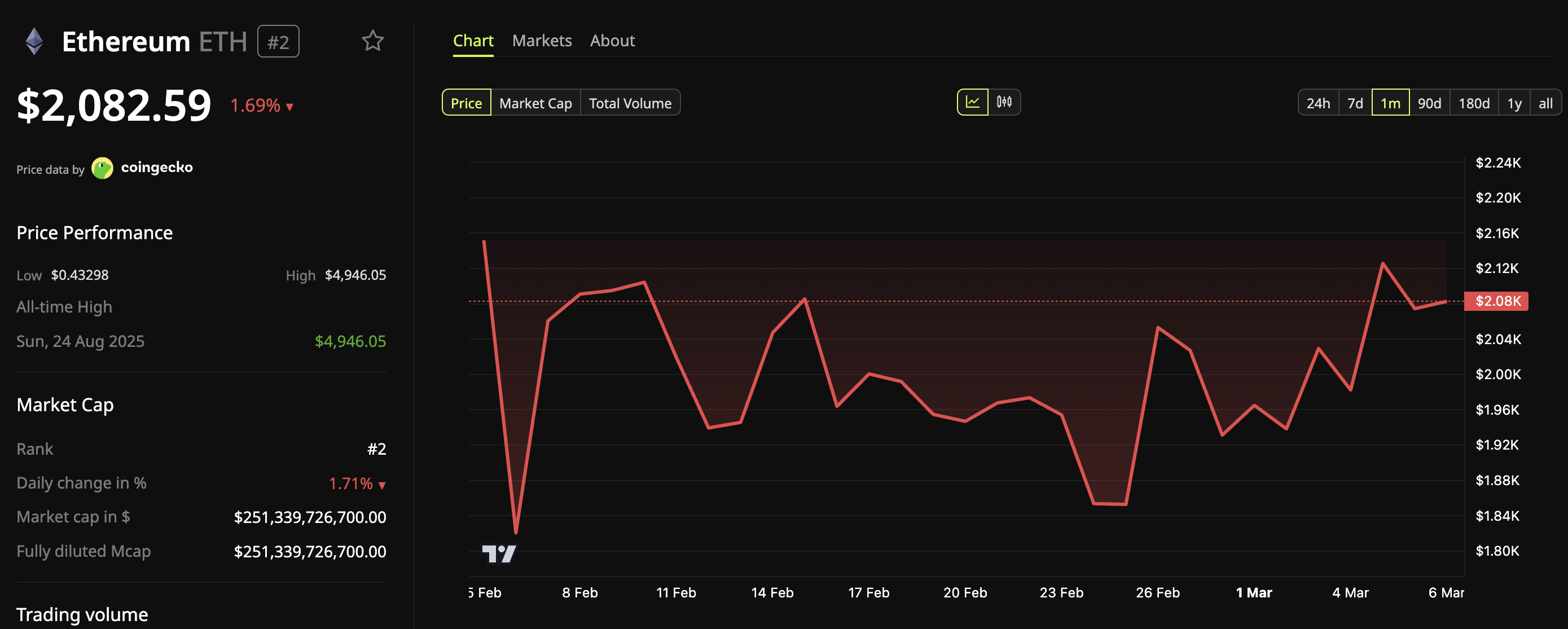
BeInCrypto Markets data showed that Ethereum’s price dropped nearly 1.7% over the past day. At the time of writing, ETH was trading at $2,082.
The post Ethereum Tops $2,000: But Culper Research Is Still Betting Against It appeared first on BeInCrypto.