

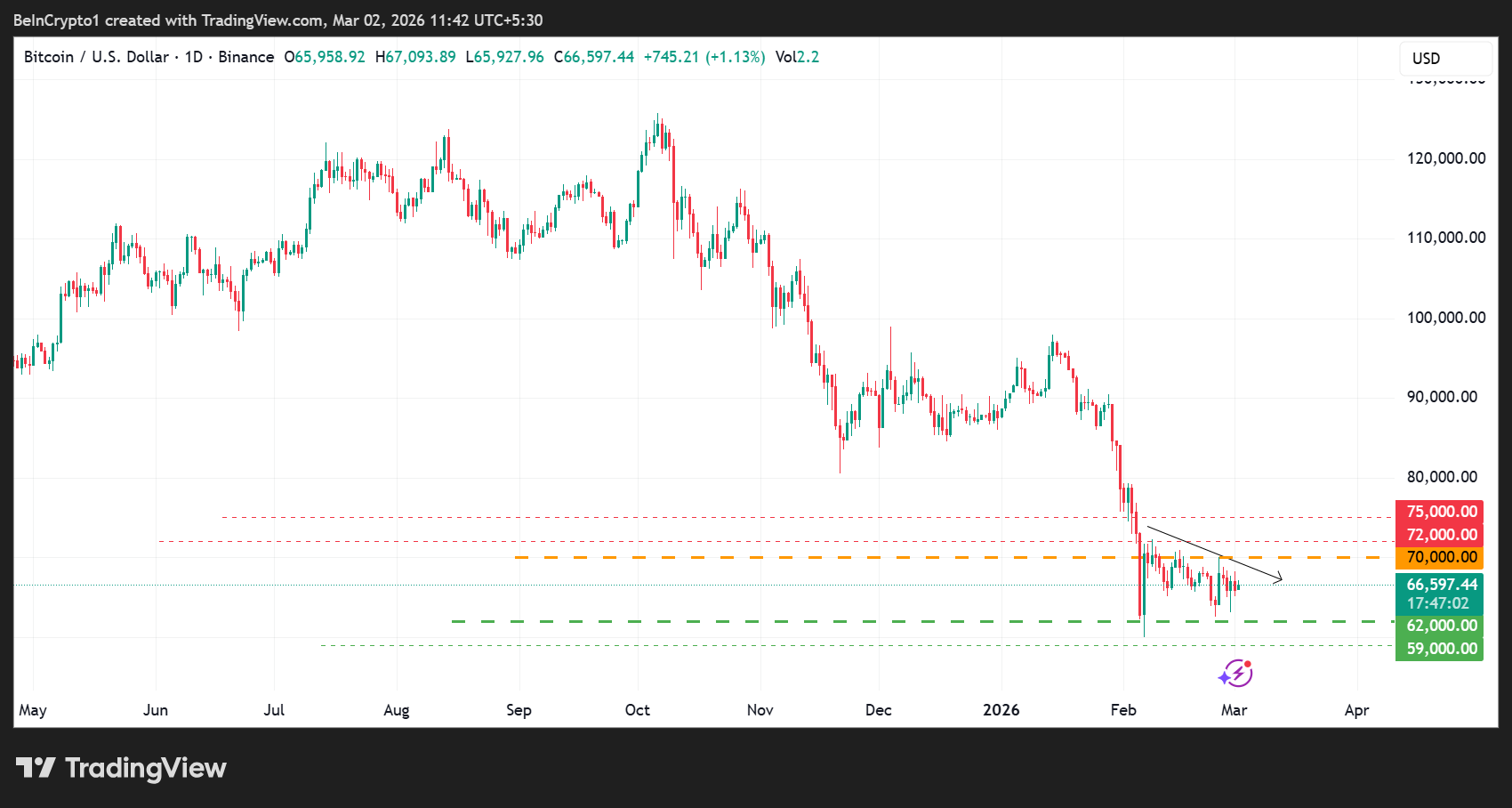
Bitcoin price enters one of the most consequential macro weeks of the first quarter, trading in the $66,000 range, down modestly amid fragile sentiment, thin liquidity, and geopolitical overhang.
After weeks of several lower highs, and with the pioneer crypto recording its weakest start to a year on record, traders are now turning to a heavy slate of US economic data that could redefine Federal Reserve (Fed) rate-cut expectations and, by extension, crypto market direction.
US Economic Data Points to Influence Bitcoin Price This Week
Below are the five key reports expected to sway Bitcoin sentiment this week.
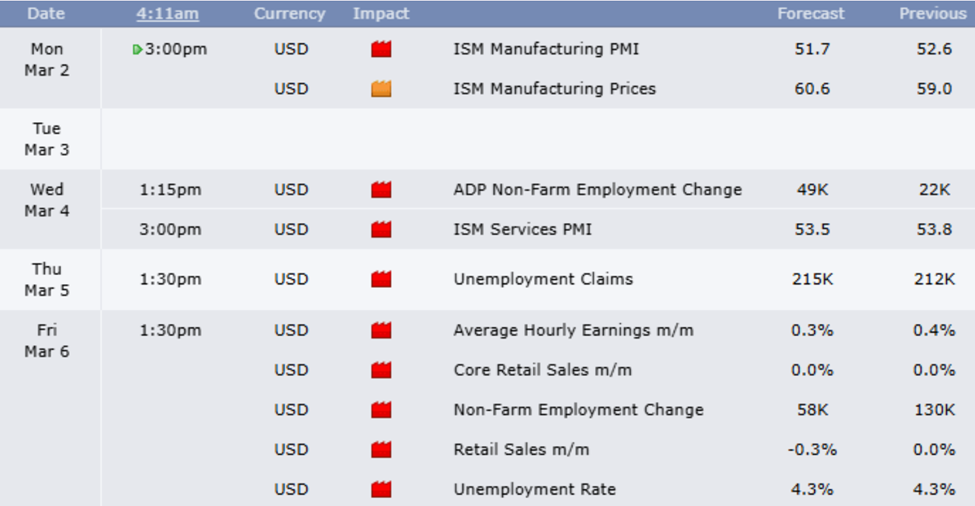
Manufacturing PMI
The week begins with February’s S&P Global Manufacturing PMI and the closely watched ISM Manufacturing PMI.
Consensus expects readings around 51.2 for S&P and 52.0–52.3 for ISM, following January’s surprise surge to 52.6, the strongest expansion since 2022.
The implications could extend to Bitcoin, where a reading above 52.5, particularly if new orders and production strengthen, would reinforce the “resilient economy” narrative.
That scenario typically delays Fed rate cuts, lifts Treasury yields and the U.S. dollar, and puts pressure on non-yielding assets like BTC.
Conversely, a drop toward 50, the contraction threshold, would shift expectations toward earlier easing. Historically, contraction combined with weak BTC positioning has delivered strong upside reversals.
“ISM above 50 is bullish for markets,” commented analyst Bull Theory.
Notably, manufacturing is not the dominant engine of the U.S. economy. However, as the week’s first catalyst, it could set the volatility tone for March.
ADP Employment Signals Labor Tightness
Meanwhile, Wednesday’s ADP Employment Change report acts as the market’s first real labor pulse for February. Economists expect roughly 50,000 new private-sector jobs, up from January’s modest 22,000 gain.
Because ADP often serves as a preview for Friday’s Non-Farm Payrolls (NFP), traders react aggressively to deviations. A strong print above 60,000–75,000 would suggest labor resilience, reinforcing the Fed’s “higher for longer” posture. That would likely push yields and the dollar higher, weighing on Bitcoin.
On the other hand, a soft reading, especially below 40,000, would revive the liquidity narrative. Signs of cooling labor conditions strengthen expectations for rate cuts later this year, which historically benefit risk assets and crypto.
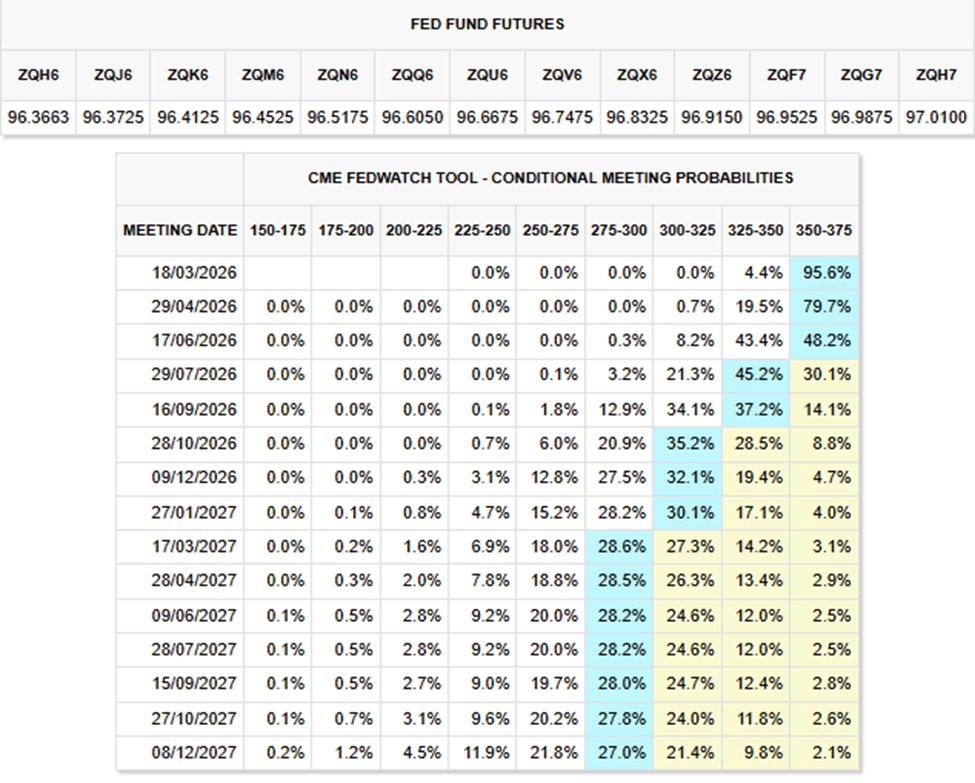
With markets already pricing roughly two to three cuts in 2026, even modest surprises could recalibrate positioning.
Services PMI
Later Wednesday, attention shifts to the services sector with the S&P Services PMI and ISM Services PMI.
Expectations sit in the 52.3–53.5 range, consistent with steady expansion. January’s ISM Services reading came in at 53.8.
Because services account for the majority of U.S. economic activity, this report carries more influence than manufacturing.
Strong services print alongside solid employment data would reinforce economic resilience, dampening hopes for near-term easing and pressuring BTC.
However, signs of slowing demand or weaker employment could quickly change the narrative. Markets remain hyper-sensitive to any indication that growth momentum is cooling.
A combined miss across ADP and services would amplify dovish bets, potentially sparking a relief rally in Bitcoin toward the $70,000 psychological level.
Jobless Claims
Thursday’s Initial Jobless Claims, expected around 215,000, versus the previous 212,000, provide a high-frequency gauge of labor-market stress.
While often overlooked compared to NFP, claims can meaningfully shape expectations ahead of Friday’s headline report.
Last week’s lower-than-expected claims reinforced tight labor conditions and coincided with BTC slipping below $68,000.
If claims remain subdued, it strengthens the hawkish case: a tight labor market limits urgency for rate cuts.
Conversely, an unexpected spike would support the cooling narrative, softening yield pressure and providing near-term support for crypto.
Given its proximity to NFP, Thursday’s release could either validate earlier signals or introduce fresh uncertainty.
Non-Farm Payrolls
Friday’s U.S. Employment Report is the week’s defining event and the highest beta catalyst. Consensus calls for approximately 54,000 new jobs in February, down sharply from January’s strong 130,000 gain.
The unemployment rate is expected at 4.3%, with hourly wages rising 0.3% month-over-month.For Bitcoin, notwithstanding, the NFP is the highest-beta macro catalyst.
A hot print, say above 80,000 jobs with firm wage growth, would reinforce the narrative that the economy remains too strong for imminent cuts.
Yields would likely spike, the dollar would strengthen, and BTC could test lower support zones near $62,000–$59,000.
A soft report, particularly below 40,000 jobs or rising unemployment, would accelerate rate-cut pricing and potentially ignite a liquidity-driven rally.
With sentiment fragile and Bitcoin trading below key resistance in the $72,000–$75,000 range, this week’s data could define March’s trajectory.
The post 5 Key U.S. Economic Reports Set to Shape Bitcoin Sentiment This Week appeared first on BeInCrypto.