The Solana blockchain turned six years old yesterday, and the community has taken the opportunity to reiterate its motto, “Just one more hard quarter.”
Although intended as a source of pride about the grit and determination of workers under the leadership of founder Anatoly Yakavenko, the motto could just as easily describe the experience of using the Solana blockchain.
Since its first multi-hour outage in 2020, Solana users have endured weeks of combined mainnet disruption, bridge collapses, wallet drains, market manipulation, and the criminal conviction of its once-most influential tokenholder and supporter, Sam Bankman-Fried (SBF).
However, after six years of near-death experiences, Solana is still here. Whether it can credit resilience or stubbornness for its success depends on the user’s perspective on those difficult times.
Even its own social media manager was conflicted, posting a birthday message with a picture that hinted at a solider in the trenches.
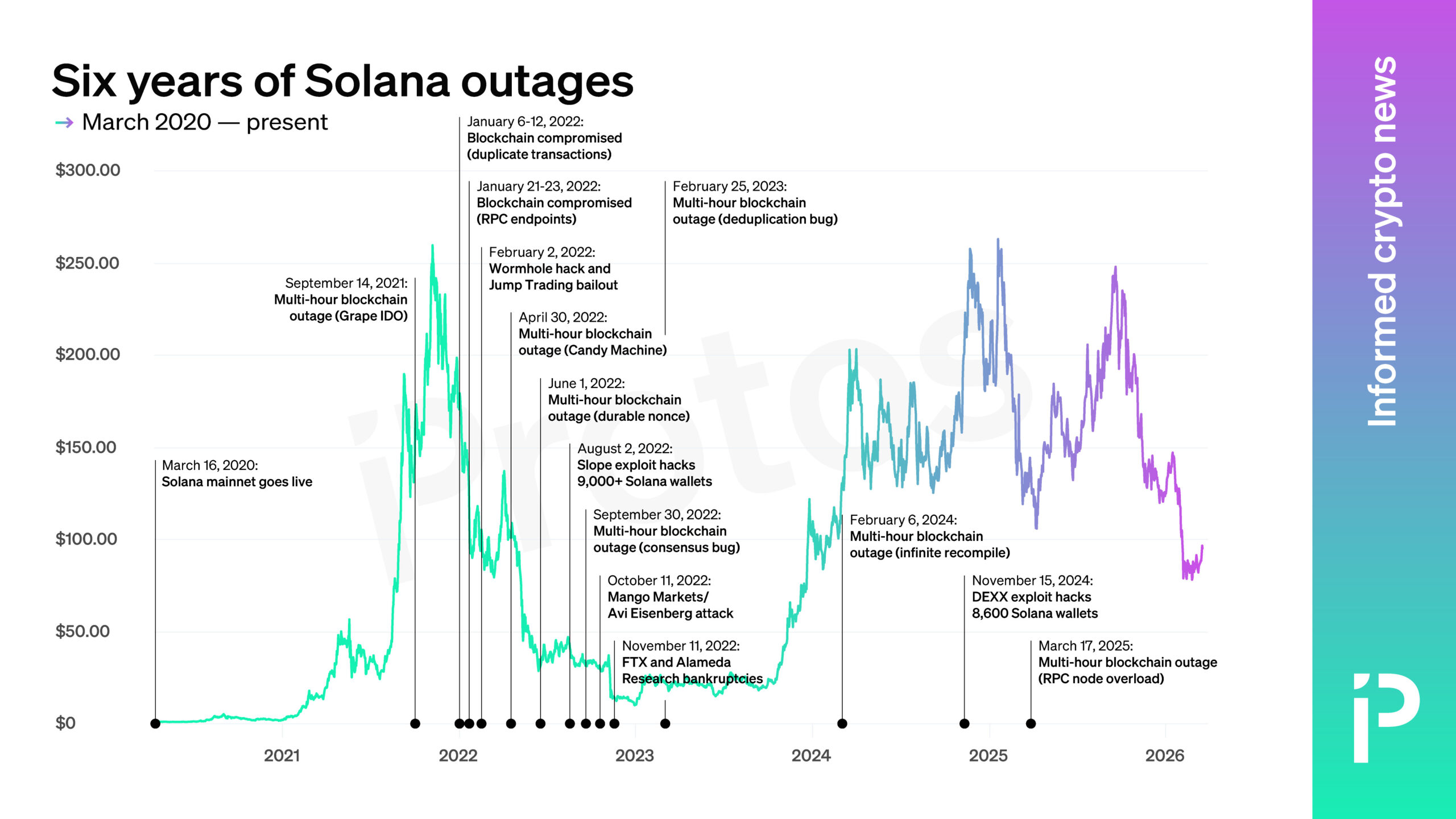
Solana outages since its founding year
Solana’s mainnet, built by former Qualcomm engineer Anatoly Yakovenko, co-founder Raj Gokal, and other developers, went live on March 16, 2020.
Their first catastrophe struck before the network’s first birthday.
On December 4, 2020, a bug in Turbine, Solana’s block propagation system, halted the entire blockchain for six hours. A validator transmitted two conflicting blocks for the same slot, and the network split into partitions.
Nine months later, a series of misfortunes began that would eventually make Solana outages so well-known that its offline status became a meme.
On September 14, 2021, bots flooded the network during Grape Protocol’s IDO on Raydium. Over 300,000 transactions per second overwhelmed validator memory. The chain went dark for 17 hours.
Then 2022 arrived. There’s no other year containing more media attention about a blockchain repeatedly failing than Solana’s outages across almost every month of 2022.
The miracle of Solana surviving 2022
Between January 6 and 12, bots spamming duplicate transactions degraded Solana’s network so badly that transaction success rates dropped 70%.
Another wave of outages from January 21 to 23 repeatedly knocked Solana’s public RPC endpoints offline.
- On February 2, hackers exploited the Wormhole inter-blockchain bridge between Solana and Ethereum, minted 120,000 fraudulently wrapped ether, and stole over $320 million. Within hours, Jump Trading covered the loss from its corporate balance sheet.
- On April 30, NFT minting bots hit the Candy Machine program with millions of requests per second, crashing Solana’s blockchain’s consensus-making. The blockchain was down for about seven hours.
- On June 1, a durable nonce bug stalled blocks for over four hours.
- On August 2, a hacker drained over 9,000 wallets of millions of dollars worth of Solana assets. Slope, a once-popular Solana wallet, had leaked private keys through a misconfigured Sentry server.
- Less than two months later on September 30, a validator’s malfunctioning hot-spare node produced duplicate blocks. A fork-selection bug halted consensus for over eight hours.
- On October 11, Avraham Eisenberg manipulated Mango Markets’ MNGO price oracle and drained over $110 million from the Solana-based exchange. A jury convicted him in April 2024.
Read more: CHART: It’s been 262 days since Solana’s last major outage
‘Sam coin’ crashes as Sam crashes
Solana’s worst days in history began on November 11, 2022. FTX, Alameda Research, and over 100 affiliates filed for Chapter 11 bankruptcy.
Founder SBF had held massive solana (SOL) positions and had become so influential in the Solana community that many people called SOL a “Sam coin” alongside FTT and his other doomed darlings.
The panic around SBF’s demise sent SOL from roughly $33 to under $10 by late December, a 97% collapse from its November 2021 cycle high of $259.
SOL bottomed below $8 in December 2022.
Going into 2023, Solana’s ecosystem hemorrhaged developers, projects, and credibility.
In fact, the bankruptcy estates of Alameda and FTX still hold hundreds of millions of dollars worth of SOL as of writing time. Bankruptcy trustees periodically unstake and liquidate tokens for creditor distributions.
Survival and Solana’s 6th birthday
Unfortunately, Solana kept breaking. On February 25, 2023, a malfunctioning validator broadcast an abnormally large block which overwhelmed Solana’s “Turbine” deduplication logic.
Yet again, the blockchain was offline for nearly an entire day.
Almost a year later, on February 6, 2024, an infinite recompile loop halted Solana’s mainnet for five hours. The bug had been spotted a week earlier but never patched.
With at least seven total blockchain outages totaling at least three full days of combined downtime, Solana users have suffered weeks of degraded performance and years of uncertainty about whether mainnet will remain stable.
Moreover, users have suffered hundreds of millions of dollars in a bridge hack, manipulations of DEX exchanges, and multiple drains of wallets affecting thousands of users.
At its worst moment, they suffered alongside the collapse of one of history’s most notorious fraudsters and dubiously generous patron, SBF.
With SOL now trading at roughly $96 per coin on its sixth birthday, Yakovenko called the celebration “six years of perfection.”
The community motto describes history more aptly: “Just one more hard quarter.”
Got a tip? Send us an email securely via Protos Leaks. For more informed news, follow us on X, Bluesky, and Google News, or subscribe to our YouTube channel.
The post CHART: Solana survived six years of near-death experiences appeared first on Protos.