

It would be more profitable for the average investor to buy a 10 year US government bond than to become a typical landlord. Indeed, this relative profitability is at its highest level since July 2007.
Negative housing spreads occur when the interest rate “spread” between low-risk US Treasuries are outperforming the risky operations of renting-out real estate.
Specifically, the US 10-year Treasury yield-to-maturity closed at 5.11% on Wednesday and pushed further to 5.18% on Thursday.
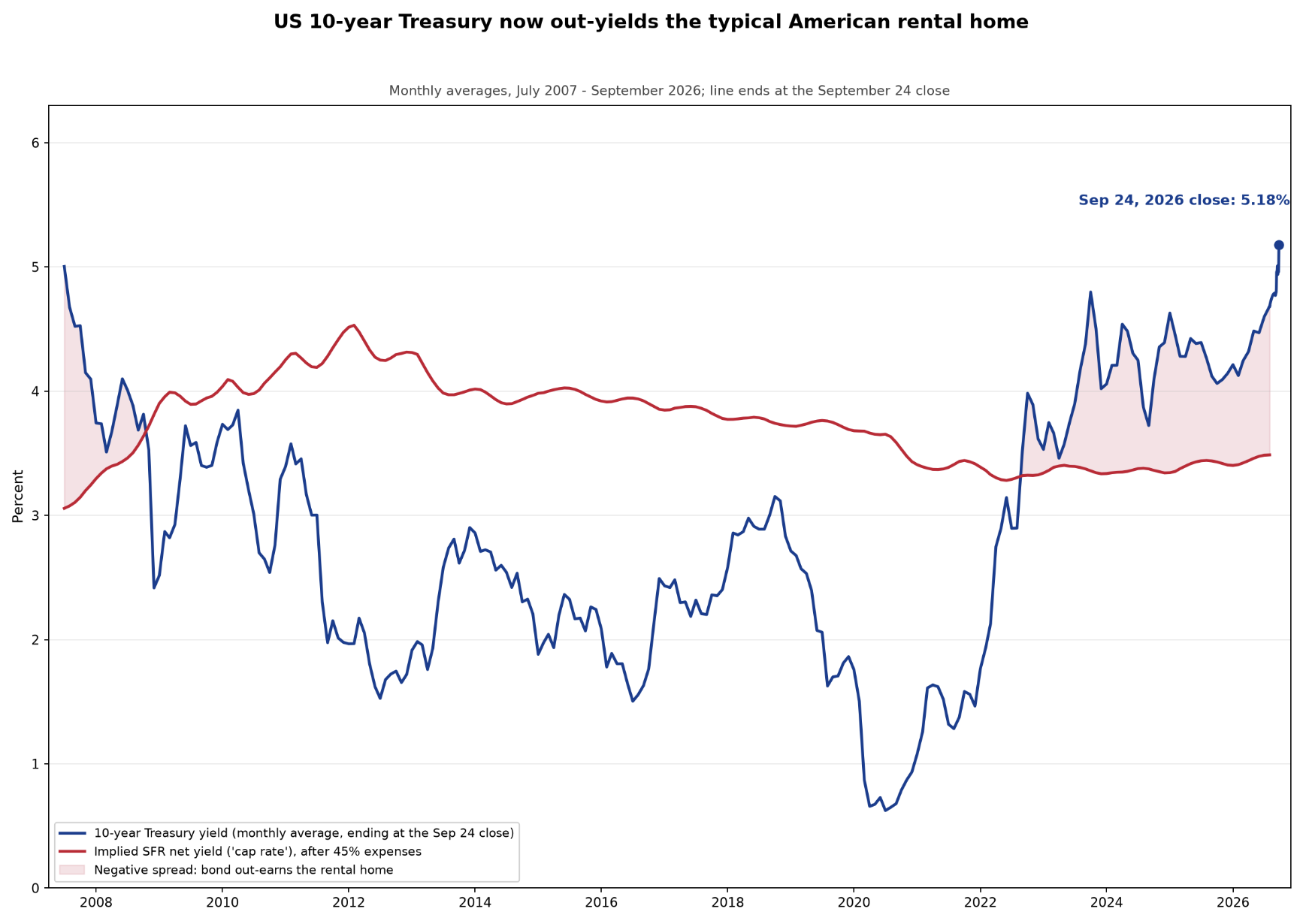
An oil shock and borrowing spree during the US war with Iran helped push Treasury bond yields to bizarre heights this year.
A recent rate hike from the Federal Reserve then catapulted yields past the 2007 housing bubble.
Last week, Chairman Kevin Warsh announced the Fed’s first hike in three years, and his committee’s own projections for an additional increase to their Fed Funds Rate this year.
Read more: US 20-year bond auction just had its worst showing ever
Negative housing spreads cause rental investment collapse
Nick Gerli, CEO of a real estate data firm, posted a chart drawing more than 250,000 views with a simple statement: Real estate for cash flow has a negative opportunity cost relative to government bonds.
According to his calculation, 10-year Treasuries above 5.1% easily beat the 4.8% single family house rental cap rate.
That 4.8% figure is one of many benchmarks for after-cost returns on rental properties. Individual property owners might earn double-digit returns during great years with minimal repairs, and then lose money the next year amid unexpected costs or low occupancy. Real estate returns vary drastically.
Got a tip? Send us an email securely via Protos Leaks. For more informed news and investigations, follow us on X, Bluesky, and Google News, or subscribe to our YouTube channel.
The post Are US Treasuries now a better investment than rental property? appeared first on Protos.