Circle is tying major financial institutions to its Arc blockchain as operators, investors, and future users ahead of its Sept. 16 mainnet launch.
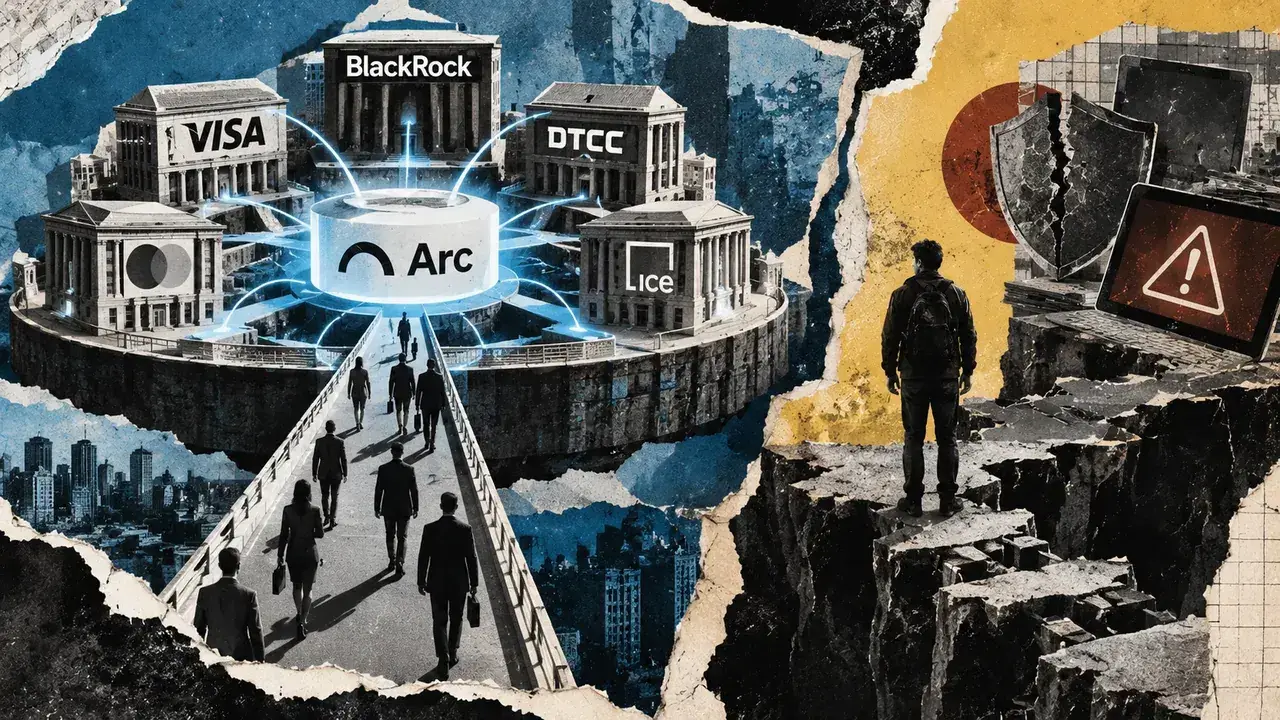
BlackRock, DTCC, Visa, Mastercard, and ICE are among 11 outside institutions Circle named as founding validators, alongside Circle itself, giving some prospective users a direct role in finalizing transactions. More than 100 institutional and ecosystem builders are already working on Arc’s private mainnet.
The relationships extend beyond network operations. BlackRock was among investors in Circle’s private sale of ARC tokens and is expected to deploy its BUIDL money-market fund on Arc. DTCC is both a founding validator and a planned integration partner, with a connection targeted for the second half of 2027 that would bring DTC-custodied assets onto the network.
Circle’s structure puts prospective customers inside infrastructure they may later depend on. It also creates a boundary for users: validators help determine which transactions become final, but their participation does not make third-party applications safe or create a claim against those institutions when an application fails.
Arc’s launch disclosures say neither Arc Network Services LLC nor its permissioned validators is responsible for the content, legality, or functionality of third-party applications and warn that blockchain use can involve transaction errors or losses without recourse.
Validator role stops at settlement
Arc is designed around deterministic finality, aimed at financial firms that need a precise point when a transaction can be treated as completed.
Its Malachite consensus engine uses a permissioned Proof-of-Authority model. A rotating validator proposes a block, and the validator set votes in two stages. More than two-thirds must pre-commit to the same block before it is finalized, after which Arc says the transactions cannot be reorganized or reversed at the consensus layer.
That gives BlackRock, Visa, DTCC, and other operators a role in maintaining a common transaction history. Responsibility for smart contracts, wallets, and financial products running on top remains separate.
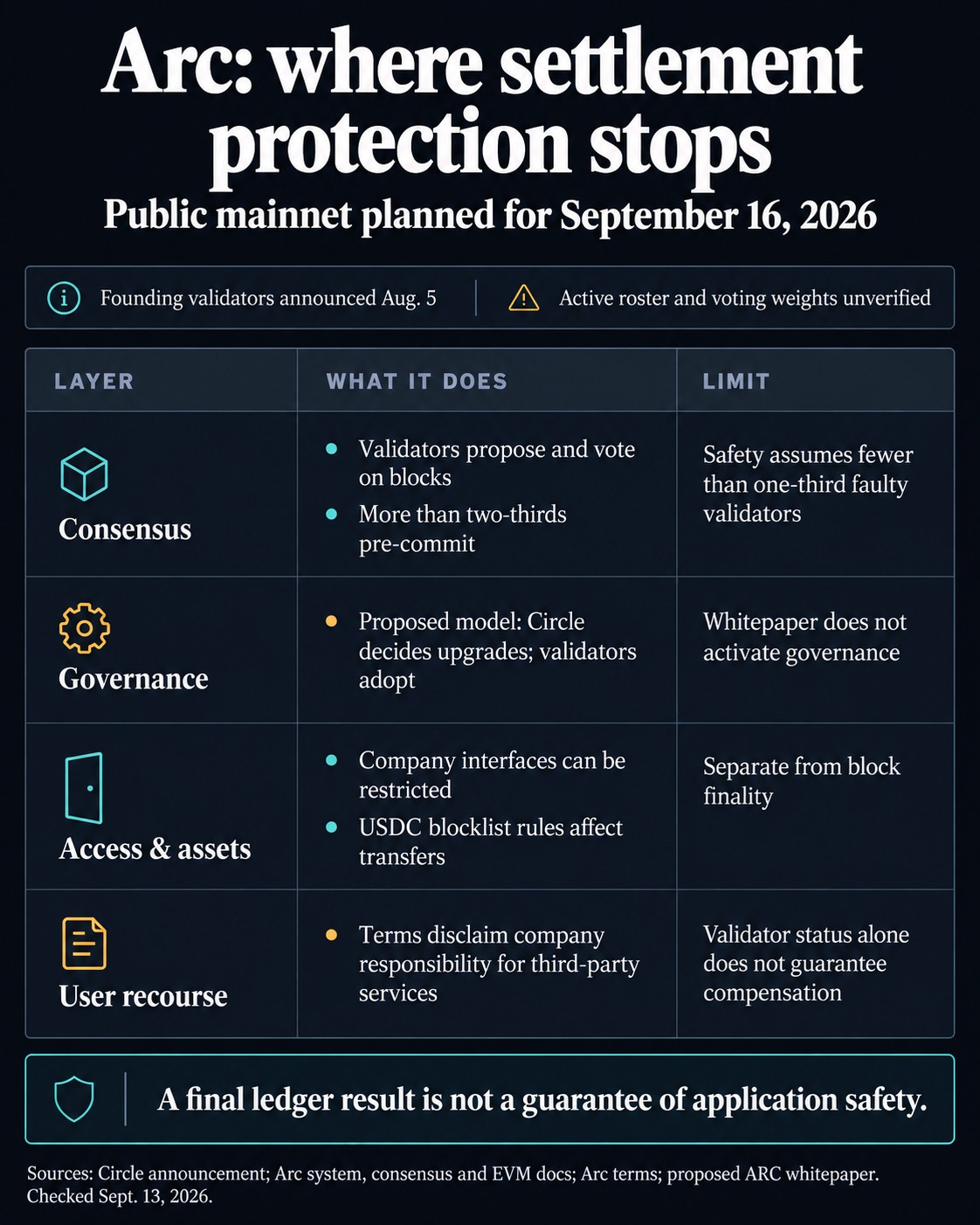
The distinction matters because Arc combines permissionless application access with permissioned validation. Developers can deploy contracts and users can submit transactions without joining the validator set, while vetted institutions continue to produce blocks.
Circle’s documentation says the launch configuration is expected to use about 20 SOC 2-certified validators across multiple regions, more than the 12 organizations publicly identified in the founding cohort, including Circle.
Circle has said validator voting power is assigned through governance, but its public launch materials do not list individual weights for the announced institutions. The precise concentration of consensus power should become clearer once the public mainnet is live.
DTCC’s planned integration shows why validator status and user protection should be separated. Circle says DTC-tokenized assets would retain the protections, rights and safeguards associated with traditionally held assets. Those protections are tied to the planned DTCC structure rather than every application running on Arc.
Circle retains a controlled launch as ARC transition looms
Arc’s institutional model leaves another question beyond transaction safety: how control over the network changes after launch.
Circle is starting Arc with a permissioned validator set while allowing developers and users open access. The company has said it ultimately wants broader participation and distributed governance, including a possible transition from Proof-of-Authority to a permissioned Proof-of-Stake model.
The economic stakes around that transition have grown. Circle agreed during the second quarter to sell 807.5 million ARC tokens to institutional investors at 30 cents each, generating about $242.2 million in gross proceeds and implying a $3 billion fully diluted network valuation.
BlackRock, Apollo, ARK Invest, ICE and Standard Chartered’s venture arm were among investors Circle named in the original presale cohort.
The ARC token has not yet launched. Circle’s whitepaper describes the token as a possible coordination asset for staking, governance and fee mechanics, while warning that its timing and final structure remain subject to change.
The presale agreements put a firmer date around that roadmap. Circle’s regulatory filings say purchasers holding a majority of the presale allocation may be able to demand repayment if the tokens are not delivered or Arc has not transitioned to Proof-of-Stake or delegated Proof-of-Stake by May 2028, subject to the agreements’ conditions.
That gives Circle a financial incentive to move beyond the launch-day structure while preserving the institutional accountability it has used to pitch Arc to banks and market infrastructure firms.
Launch turns announced relationships into a live test
The first measure on Sept. 16 will be whether the validator network operates as described and which institutions are active when public access opens.
The larger commercial test will take longer. BlackRock’s BUIDL deployment remains expected rather than completed, while DTCC’s tokenization connection is scheduled for the second half of 2027.
Their arrival would deepen the overlap Circle is creating at launch: institutions securing the network while also moving assets and financial activity across it.
That overlap could help Arc solve an infrastructure problem by giving large prospective users a reason to trust the settlement layer they help operate. It also segments responsibility. A validator can help make a transaction final while the application provider, asset issuer or custodian remains responsible for what the transaction represents.
Circle now has to turn its announced validator cohort into an operating network, then show that those relationships produce real settlement activity.
The next disclosures around active validator participation, voting power and ARC’s transition path will determine how much of Arc’s trust model rests on the institutions operating the network and how much remains with Circle.
The post Circle’s Arc launch ties Wall Street firms to the network without making them its safety net appeared first on CryptoSlate.