

A trader has lost more than $2 million on Polymarket in just over a month, with a single position accounting for nearly 79% of the total loss.
As prediction markets gain traction across the crypto sector, more traders are shifting toward outcome-based platforms in search of new opportunities. However, this growing trend also raises concerns about whether participants fully understand the distinct risks associated with betting on real-world events, as opposed to price movements.
How a 51% Win Rate Still Led to Massive Losses
In a detailed thread on X (formerly Twitter), blockchain analytics platform Lookonchain highlighted a trader, beachboy4, whose losses on Polymarket exceed $2 million. The post outlined the trader’s activity and risk exposure over a 35-day period.
According to the data, the trader placed 53 predictions during that time, recording 27 winning positions for a win rate of approximately 51%. Despite this, the overall performance was heavily impacted by several high-risk trades.
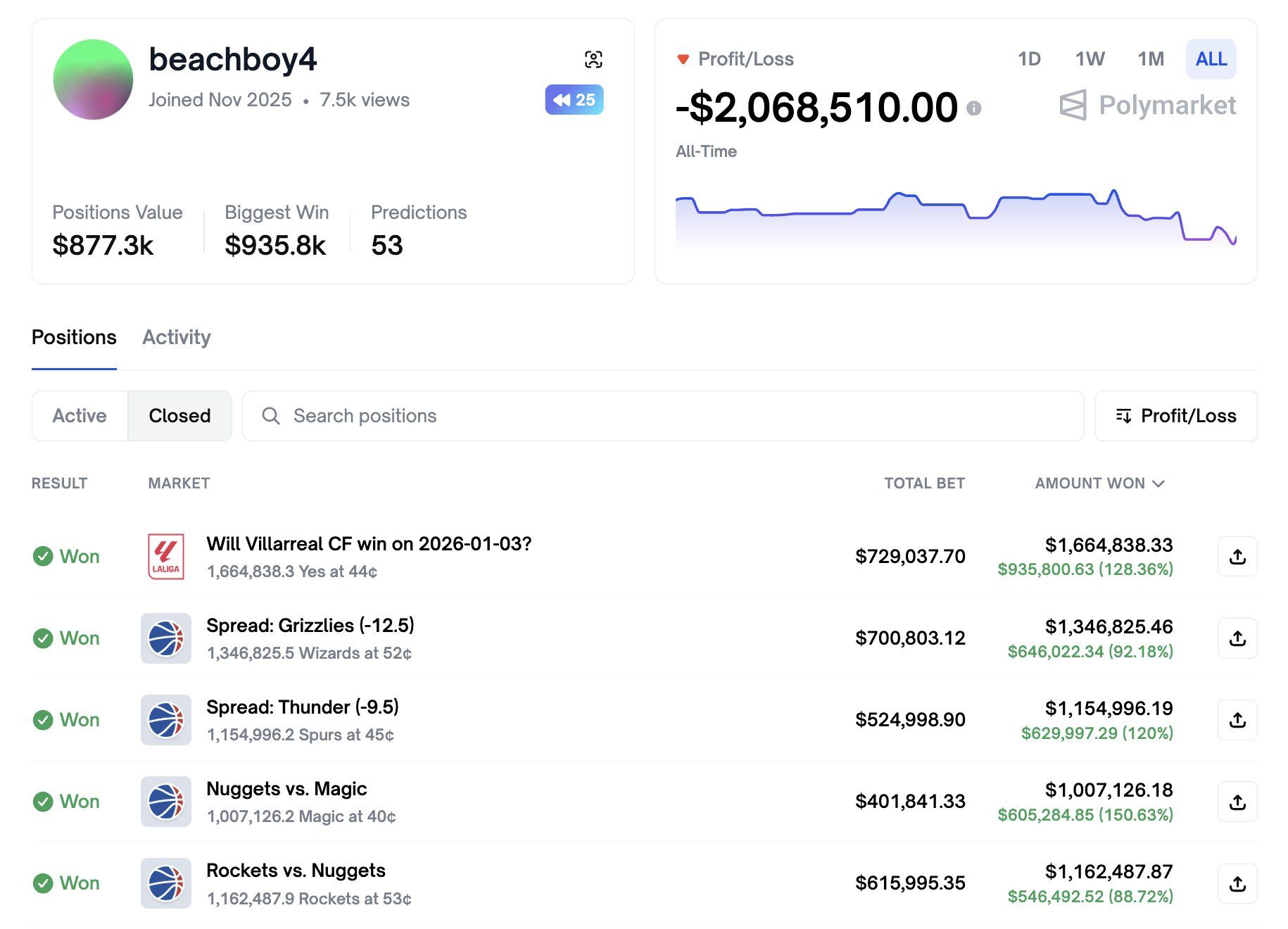
Lookonchain noted that the trader’s average bet size was around $400,000. The trader’s largest gain reached $935,800. Meanwhile, the biggest loss totaled $1.58 million, stemming from a single bet on Liverpool to win, purchased at a price of $0.66.
“Buying ‘YES’ at $0.66 does not mean: ‘Liverpool is likely to win’ It means: ‘I believe the true probability is higher than 66%.’ Polymarket is a probability market, not a bookmaker. This trader consistently treated Polymarket like binary sports betting, not probability trading. This single mistake is enough to explain most of the losses,” Lookonchain stressed.
The report further highlighted a recurring pattern in the trader’s losses, with entry prices across major losing positions clustered between $0.51 and $0.67. These trades typically offered a limited upside of 50% to 90%.
Yet, they carried a potential downside of 100%. Lookonchain described this as the “worst payoff structure” on Polymarket, combining capped gains with total-loss risk.
Furthermore, the trader did not employ basic risk management strategies, such as setting early exits, creating hedges, or applying probability-based stop-loss mechanisms. Instead, losing positions ran to zero, magnifying the impact of any incorrect prediction.
The pattern repeated across multiple markets, including NBA spreads and major soccer matches. Lookonchain noted the loss came from fundamental flaws, not just bad luck.
“The trader wasn’t unlucky. This wasn’t bad luck. This wallet had: Negative payoff asymmetry, No defined max loss per position, No edge in efficient markets, No probability discipline, Loss was inevitable.”
Lookonchain Highlights Common Mistakes in Prediction Market Trading
The case reflects how losses can accumulate in prediction markets despite a positive win rate. Lookonchain shared several practical rules to avoid similar outcomes.
- Avoid high-price entries: Positions entered at elevated prices leave little margin for error. Traders should be especially cautious when buying above 0.55 and avoid entries at 0.65 or higher unless they possess a clear informational or analytical edge.
- Enforce strict position sizing per outcome: Exposure to any one event should generally be limited to 3% to 5% of total capital. This approach ensures that even a complete loss does not materially damage long-term trading viability.
- Manage positions dynamically before resolution: Partial profit-taking can secure gains during favorable moves, while early exits can limit losses when odds deteriorate. Holding positions until final resolution is not always the optimal strategy.
- Compare win rate to break-even levels: Win rate alone is not enough. Compare results to the break-even rate. If performance falls below that level, stop and reassess.
- Remove consistently unprofitable markets: Repeated losses signal a lack of edge. Do not force recovery. Exclude those markets entirely to protect capital.
Broader Lessons on Risk and Leverage in Crypto Trading
The lessons from beachboy4 echo a broader pattern seen across recent crypto trading losses. Previously, BeInCrypto highlighted how leveraged traders such as James Wynn, Qwatio, and others suffered massive drawdowns after taking outsized risks in highly efficient markets.
These cases underscore recurring behavioral pitfalls in both crypto trading and prediction markets. Overconfidence following early wins, poor position sizing, and the absence of clear exit strategies frequently lead to significant losses.
Although disciplined traders can profit by using proper risk controls, most retail participants are unprepared for these structural dangers. As traders shift to outcome-based markets, the need for education on probability and risk management is greater than ever.
The post How A Trader Lost $2 Million on Polymarket: 5 Mistakes You Need to Stop Making appeared first on BeInCrypto.