
Key Takeaways
- Midnight City makes privacy tech visible. Autonomous AI agents generate live activity that shows Midnight’s privacy model in action.
- Selective disclosure offers controlled visibility. Transaction details can be revealed only to the right parties while the rest stays private.
- Midnight City connects privacy, scale, and AI agents. The simulation shows how private systems could support agent-driven on-chain activity.
There’s an overlooked messaging problem in privacy architecture.
Proofs are generated, data stays protected, and selective disclosure works quietly in the background. That makes it hard for privacy-focused networks to show people what they actually do, because most of what matters happens out of view. Project.docs and a GitHub repository don’t always scratch the itch.
Midnight City is Midnight’s answer. Presented as a live simulation running on the Midnight network, it turns the protocol’s core ideas into a digital city populated by autonomous AI agents generating transactions, activity, and proofs in real time.
This is meant to demonstrate rational privacy and scalability under sustained conditions. It serves as a public-facing proof of concept for how Midnight wants privacy to be understood.
What Is Midnight City?
At a functional level, Midnight City is designed as a live interface for the Midnight network.
Midnight describes it as an interactive front page powered by autonomous AI agents, each generating transactions, conversations, and economic activity inside a continuously running digital city.
It gives the network a way to demonstrate behaviour under pressure. The city’s value comes from its ability to demonstrate persistent activity, transaction flow, and the mechanics of a privacy-preserving system operating at speed.
Midnight itself is a privacy-focused blockchain platform built to support something called selective disclosure. It’s designed to let users, applications, and businesses keep sensitive data private while still revealing specific information when needed.
More About Selective Disclosure
The strongest part of Midnight City’s value proposition is selective disclosure, meaning information does not have to be either fully public or fully private. Instead, different parts of a transaction can be revealed only to the people or entities that are meant to see them, while everything else stays protected.
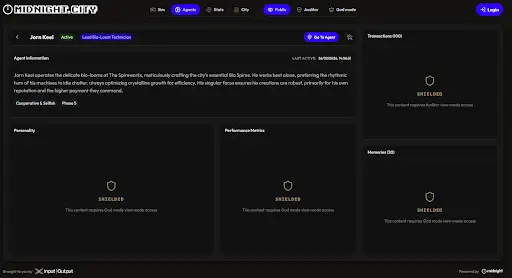
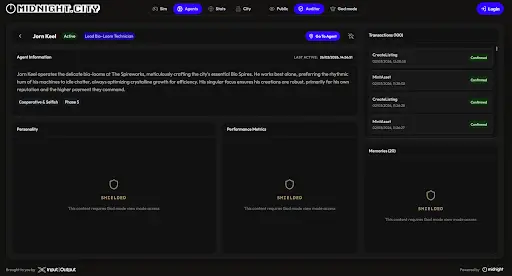
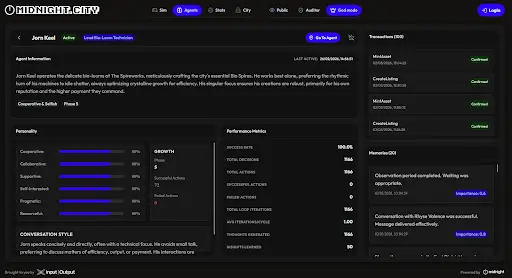
Rather than treating privacy as a simple binary between hidden and visible, the simulation lets users inspect the same transaction through different permission layers.
In public mode, only the data committed openly to the chain is visible, while private details remain shielded.
Auditor mode shows how specific information could be revealed to authorised entities through cryptographic permissions, showing how compliance and confidentiality might coexist.
Then there is God mode, a simulation-only looking-glass that exposes the private context available to the individual actor, including memory, personality, and behavioural history. Privacy shouldn’t make systems opaque in Midnight’s view. Instead, it should be about controlling who gets to see what, when, and for what reason.
The Infra Angle
Midnight says the simulation is built to handle substantial transaction volume through a dedicated Layer-2 scaling design, where each shielded transaction is first proven with a zero-knowledge proof before batches are re-executed inside Trusted Execution Environments and committed back to the base network through cryptographic attestation.
The system is trying to prove that privacy does not have to come at the expense of throughput or verifiability. For privacy-focused networks, that is a meaningful claim to demonstrate publicly. It moves the conversation away from whether confidential systems can work in theory and toward whether they can sustain the kind of constant economic activity that real applications would demand.
AI Agents and Intent Privacy – Right on Time
Midnight City arrives as privacy infrastructure is starting to intersect more directly with agentic systems.
Midnight says the simulation’s autonomous agents are actors with distinct personalities, long-term memory, goals, and behavioural patterns that evolve through interaction.
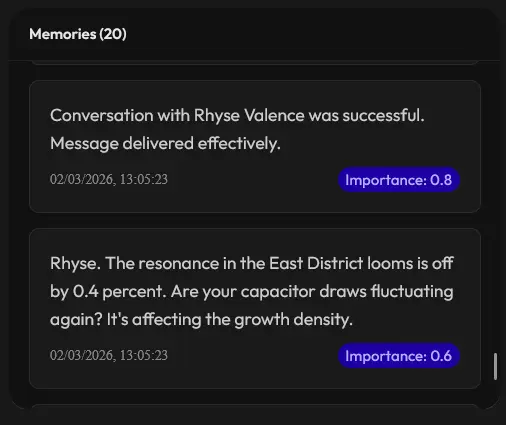
That gives the city a second function beyond transaction generation, turning it into a testbed for how private systems might support AI-driven activity without exposing the logic behind every action.
This is where Midnight’s focus on intent protection comes in. If an agent’s strategy, conditions, or reasoning become visible before execution, they can be exploited by other participants. This is why, in Midnight City, actions may settle on-chain, but the context behind them can remain private.
Moreover, the simulation feels timely, as it places Midnight between two developing trends in crypto infrastructure – privacy-preserving computation and the coming wave of agent-led on-chain coordination.
Final Thoughts
Midnight City gives Midnight something many infrastructure projects struggle to produce – a way to make a technically dense thesis feel observable.
The project is set to expand further, with Midnight outlining plans to let users create custom agents, interact with them directly, and take part in shaping how the city evolves.
If the project stays true to its roadmap, the simulation could act as an ongoing public sandbox demonstrating how selective disclosure, scalable privacy, and protected intent work.
For Midnight, that’s the real significance here. In a market full of protocols that can describe their architecture, Midnight City gives the network a chance to show and tell.
The post A Digital City Populated by Autonomous AI Agents? Sign Me Up, Midnight. appeared first on BeInCrypto.