President Trump’s April 1 address on the Iran war promised two to three more weeks of intense military strikes, reversing a two-day stock market relief rally and sending oil above $110 per barrel.
The speech divided US stocks into clear winners and losers. BeInCrypto analysts identified three stocks where the impact was most visible. The list includes one energy name riding the war premium higher.
The list also has two oil-dependent companies whose recoveries were cut short within hours. The selection is based on price reaction, chart structure, and the degree to which each business model directly connects to sustained oil prices.
APA Corporation (NASDAQ: APA)
APA Corporation (APA) is among the US stocks that have benefited most directly from the Iran conflict. As a pure-play oil and gas exploration and production (E&P) company, every dollar increase in crude flows almost directly to APA’s bottom line.
Trump’s pledge to continue strikes and his threat to target Iran’s energy infrastructure signal sustained supply disruption, which supports elevated crude prices for the foreseeable future.
The daily chart shows that APA has rallied approximately 96% since early January, forming a clear pole-and-bull-flag pattern. Since March 30, prices have consolidated inside a flag.
Chaikin Money Flow (CMF), a proxy for institutional buying and selling pressure, has been consistently making higher highs throughout the rally, currently reading 0.18.
That persistent institutional inflow confirms that big money is backing the move rather than fading it.
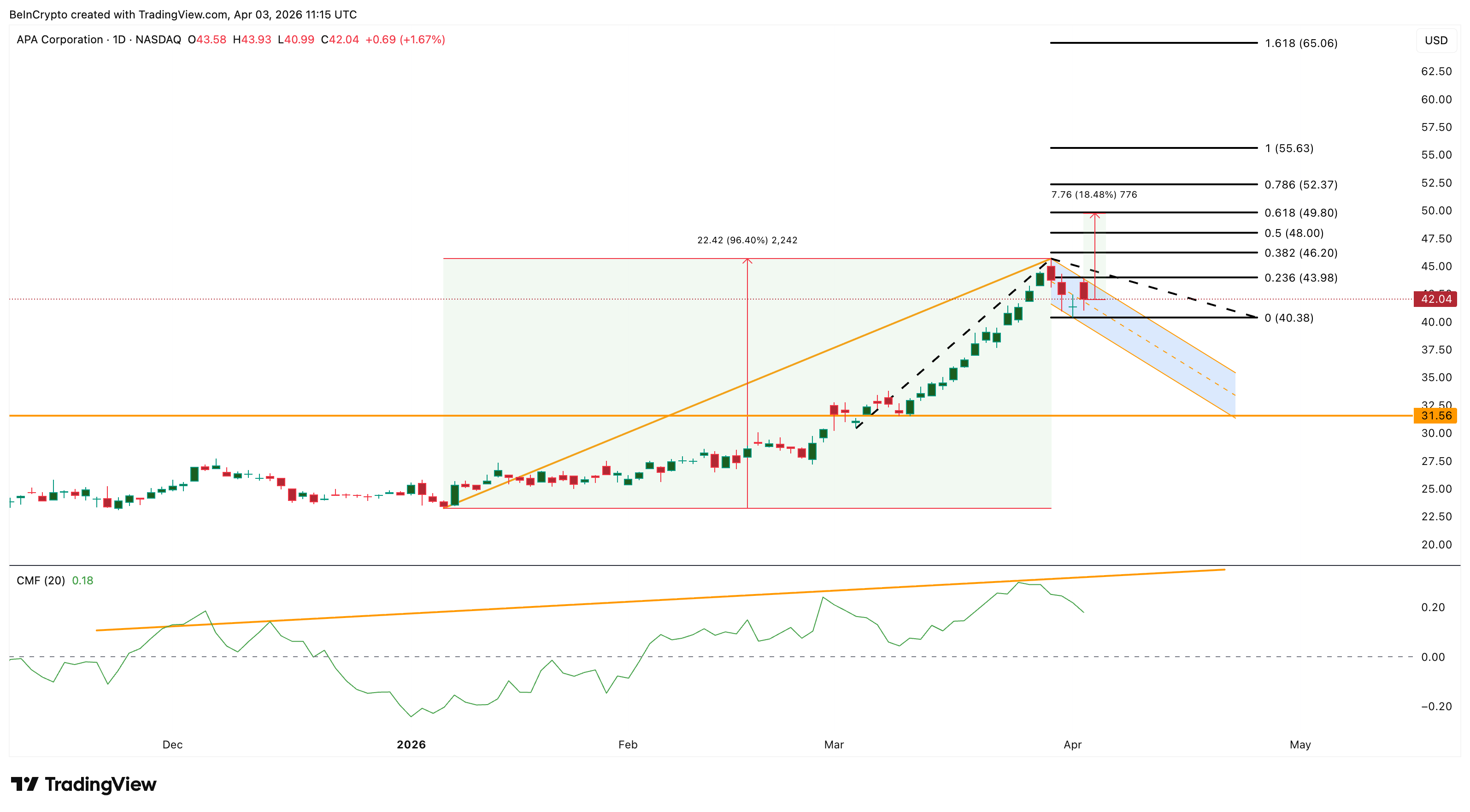
On April 2, APA’s share price peaked at $43.93 but failed to break the upper trendline of the flag. A clean close above $43.98 would confirm the breakout and target $49.80 initially, followed by $55.63 and $65.06 on the extended projection.
However, a break below $40.38 would end the flag prematurely, though a full invalidation of the bullish structure would require a move below $31.56.
Carnival Corporation (NYSE: CCL)
Carnival Corporation (CCL) sits on the opposite end of the oil price chain. As the world’s largest cruise operator, fuel represents one of its highest variable costs.
Rising oil compresses margins directly, while sustained geopolitical uncertainty dampens consumer willingness to book voyages, creating a double headwind that few sectors absorb as severely.
Since peaking at $34.05 on February 6, Carnival stock has been trading inside a bearish descending channel on the daily chart. It fell approximately 10% over the past month as oil prices climbed.
A bullish divergence had been forming from mid-November to late March, in which the price made a lower low while the Relative Strength Index (RSI), a momentum oscillator, made a higher low.
That divergence suggested weakening sell-side momentum and triggered a bounce as de-escalation hopes lifted markets earlier in the week.
Trump’s speech reversed the setup. The bounce stalled, and prices fell 3.54% on April 2 as the two-to-three-week war extension reignited fears of prolonged $110 oil.
The bullish divergence technically remains intact, meaning a recovery is still possible if de-escalation resurfaces. However, the path of least resistance points lower as long as oil stays elevated.
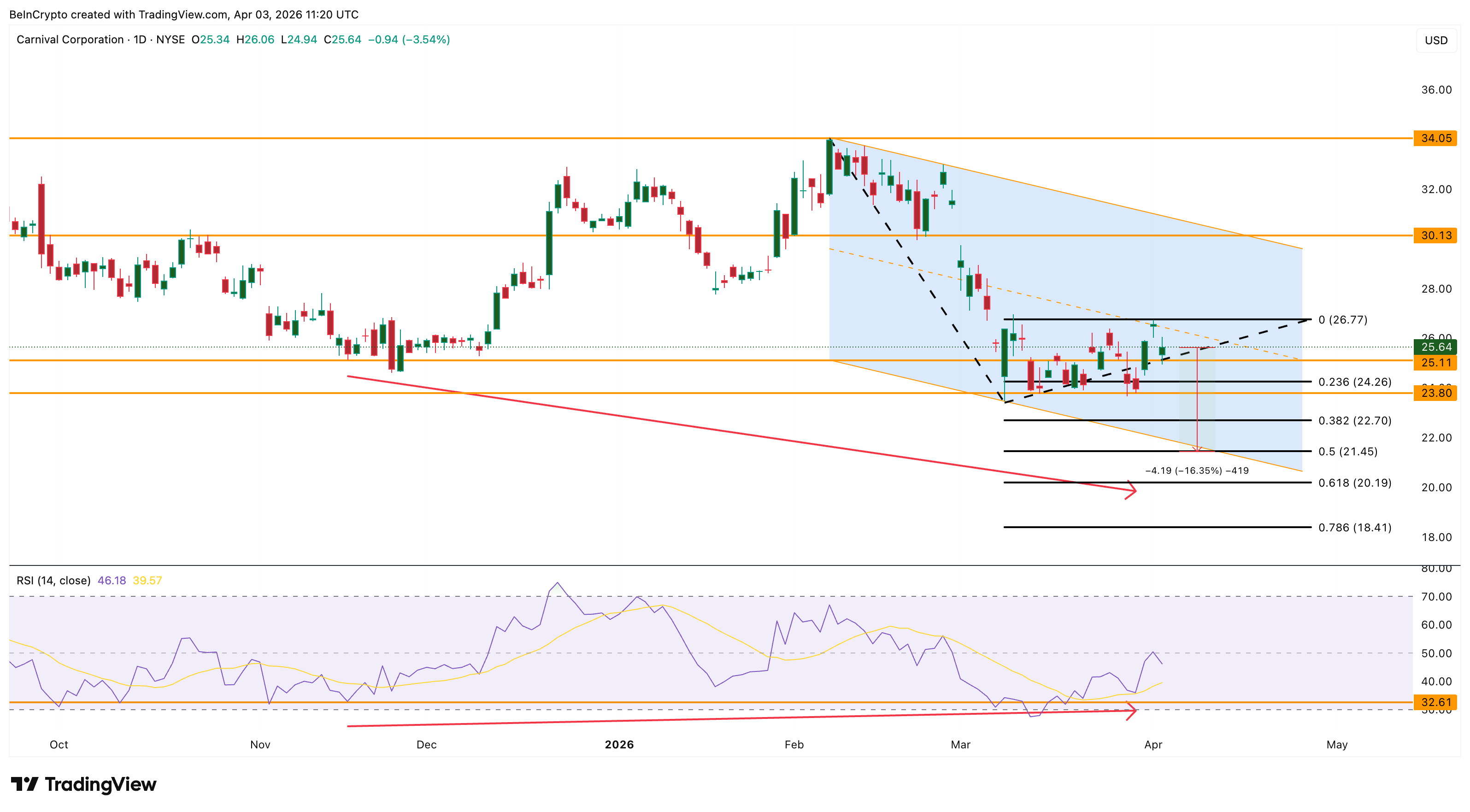
A move above $26.77 would begin to shift momentum, with $30.13 as the level that turns the structure neutral. On the downside, $23.80 acts as immediate support.
A break below $21.45 would confirm a pattern breakdown and open the path toward $20.19 and $18.41.
United Airlines Holdings (NASDAQ: UAL)
United Airlines Holdings (UAL) experienced perhaps the most dramatic whiplash among US stocks this week. Jet fuel typically accounts for 25-35% of an airline’s operating expenses, making airline stocks among the most oil-sensitive equities in the market.
When oil rises, margins compress immediately because airlines cannot pass fuel costs to passengers fast enough through surcharges.
Between March 27 and April 1, UAL’s share price surged 14%. De-escalation hopes pushed oil lower and lifted the entire travel sector. That rally brought the price back above the 20-day Exponential Moving Average (EMA), a short-term trend indicator that gives greater weight to recent price action, at $93.71.
Trump’s speech erased the recovery. UAL fell approximately 8% from its April 1 high, closing at $92.21 on April 2, a 3% daily loss. The drop pushed the stock back below the 20-day EMA, which matters because the last time UAL reclaimed it on February 3, it preceded a 9% rally. Losing it now removes that short-term floor.
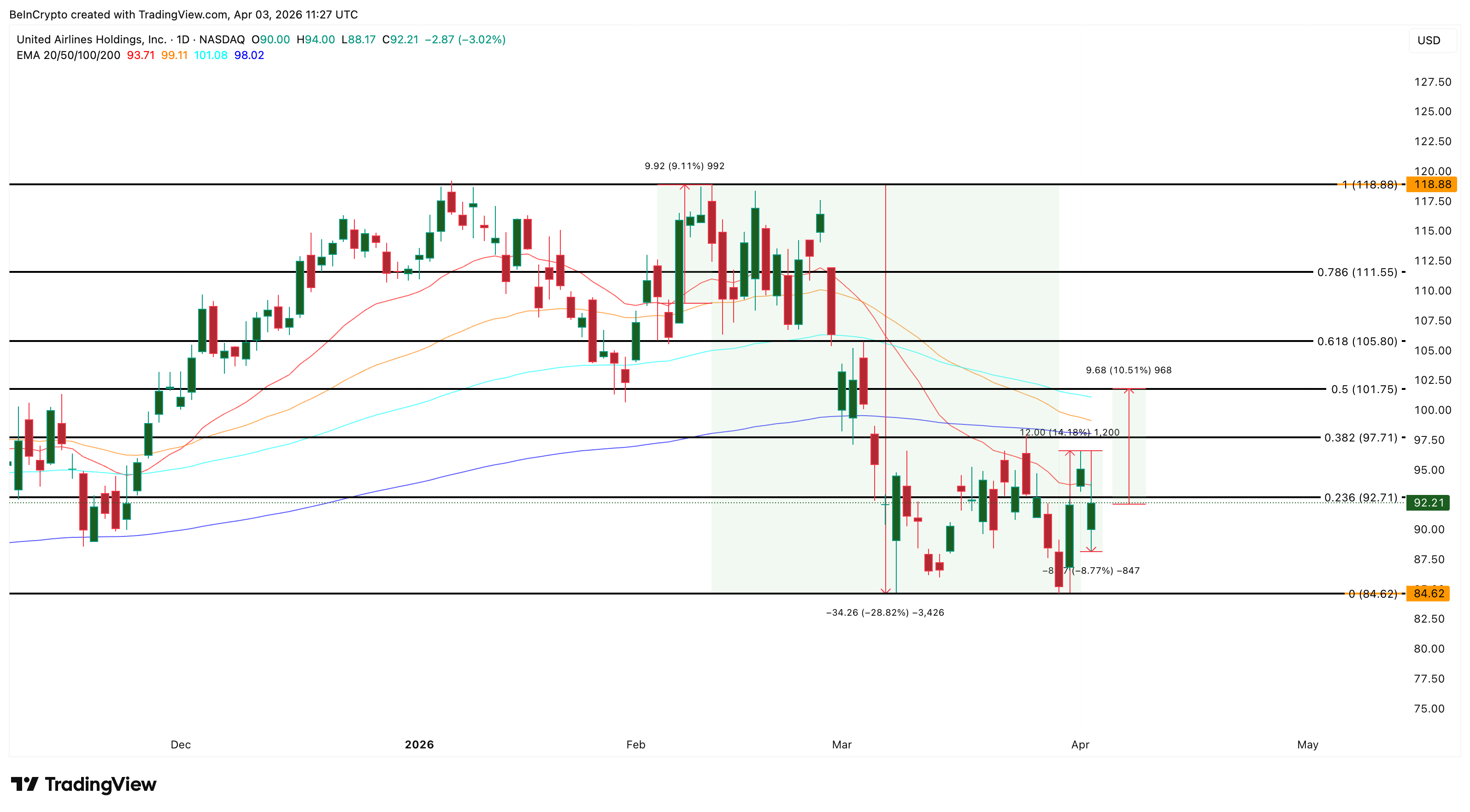
The broader damage is substantial. Since early February, UAL has fallen 28%. Right from $118.88 to its March 30 low of $84.62. The dip was driven entirely by oil-related margin fears.
If markets reopen on Monday with positive developments, reclaiming $93.71 would restore the 20-day EMA floor.
Above that, $97.71 and $101 become the next targets, with $101.75 aligning closely with the 50-day and 100-day EMAs. A move above $101.75 would place UAL above every major moving average for the first time since early February.
However, if oil stays above $110 and the war timeline extends, $84.62 remains the floor. A break below that level exposes deeper downside.
The post 3 US Stocks Heavily Affected by Trump’s Iran Speech This Week appeared first on BeInCrypto.