
Ownership coins are set to transform decentralized governance in 2026, with analysts forecasting that at least one project will surpass a $1 billion market cap.
Unlike current governance tokens, ownership coins combine economic, legal, and governance rights in one asset. This development could solve longstanding issues that have challenged decentralized autonomous organizations (DAOs) for years.
How Ownership Coins Differ From Traditional Governance Tokens
Traditional DAO governance tokens generally offer only voting rights, lacking real economic power or legal accountability within decentralized organizations. This limitation introduces investment risks and weakens the goal of truly decentralized governance.
Ownership coins offer a major shift in design. According to research from Galaxy Digital, these tokens unite economic, legal, and governance rights within a legally enforceable digital asset. This integrated approach aims to fix accountability issues that have affected DAOs since their start.
Galaxy Digital describes this model as creating “digital companies” in which onchain governance holds legal weight rather than relying only on social consensus.
Token holders thus gain meaningful and enforceable control over digital organizations with tangible assets. This innovation creates a path toward legally recognized, self-governed on-chain entities.
MetaDAO was among the first to use this framework, applying futarchy principles, a governance system using prediction markets instead of direct votes.
The project launched on Solana in November 2023, guiding decisions with trading in prediction markets rather than traditional voting methods.
Messari Report Identifies AVICI as Top Performer
The Messari Theses report positions ownership coins as a major investment opportunity for 2026. It spotlights AVICI as the biggest winner over the past year, highlighting the sector’s growth prospects.
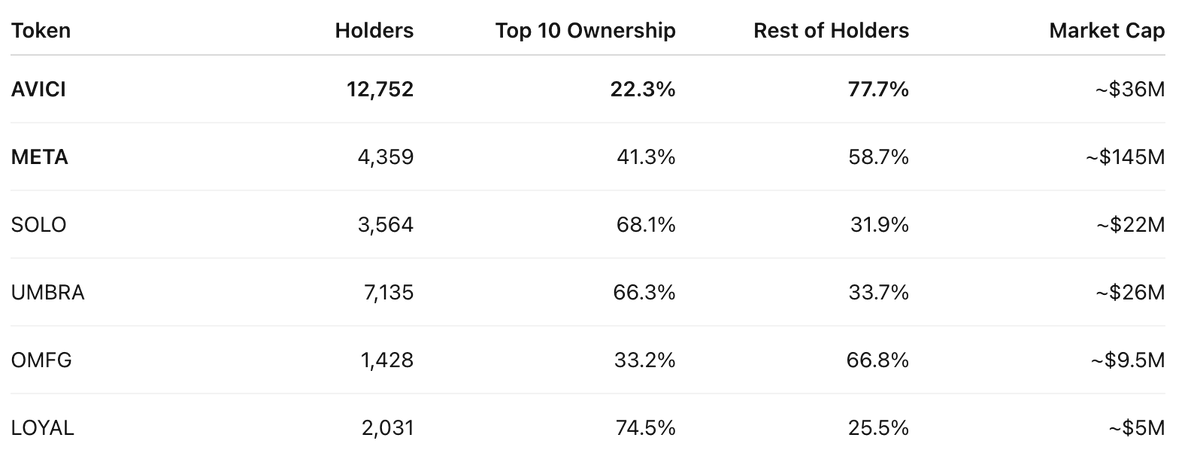
AVICI has shown strong holder retention and broad distribution, despite price volatility. As of mid-December 2025, the token counted 12,752 holders and maintained a low concentration among large holders.
Analyst crypto_iso shared that AVICI began with 4,000 holders and reached 13,300 within 45 days.
During a steep 65% price decline, AVICI lost only 600 holders, just 21% of its initial growth rate. On average, the coin added 200 holders per day at its peak and lost about 43 per day during the downturn. These numbers signal community resilience despite market fluctuation.
Sector Remains Early-Stage, Offering Potential for Growth
The ownership coin market is viewed as a new frontier with substantial upside, as no project yet has exceeded a $1 billion fully diluted valuation. Many investors see this as untapped potential for significant gains.
“My biggest bet for 2026 are ownership coins. They are in early stage right now, not a single coin above 1B mcap. Opportunity right in front of you,” wrote analyst Anglio.
Much of the discourse on social media calls 2026 the “year of the ownership coin.” The blend of authentic innovation and early entry point is attracting interest from retail and institutional investors alike.
Ownership coins may solve barriers that have limited DAO growth and investment. Their legally binding onchain governance systems can let blockchain-native organizations function as true business entities.
This step could impact capital formation, investor protection, and the development of decentralized governance.
Nevertheless, this market is still in its infancy. Most ownership coin projects remain under development, and legal clarity for these hybrid entities varies across regions. Whether this innovation can fulfill the aspiration of self-governing onchain organizations will depend on successful implementation in 2026.
The post $1 Billion by 2026? Analysts Eye Ownership Coins as Crypto’s Next Governance Game-Changer appeared first on BeInCrypto.